

PHOTOS BY MIGUEL DIMAYUGA AND ABELARDO MARTIN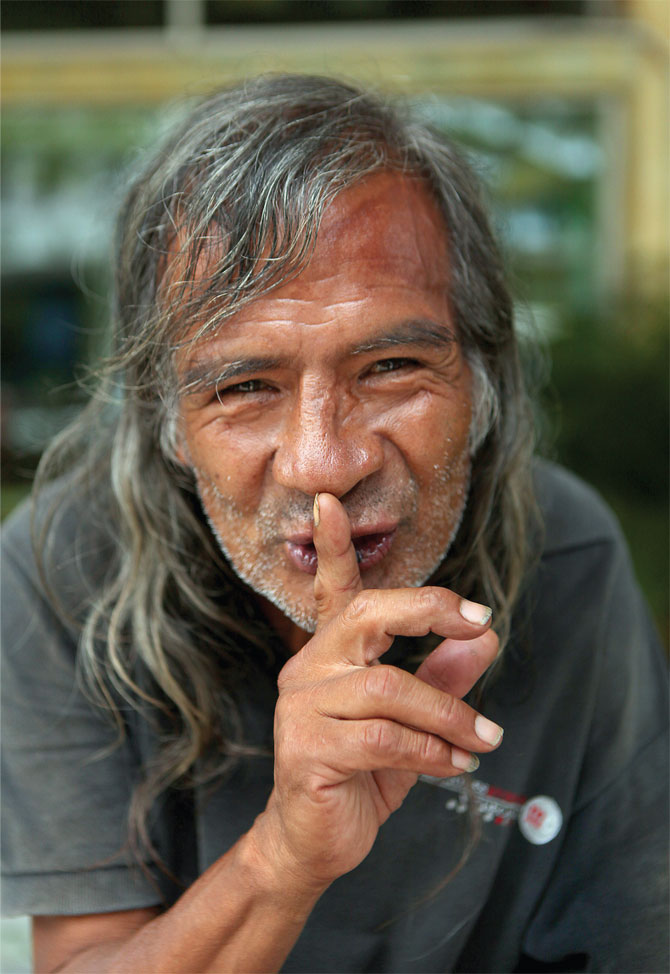
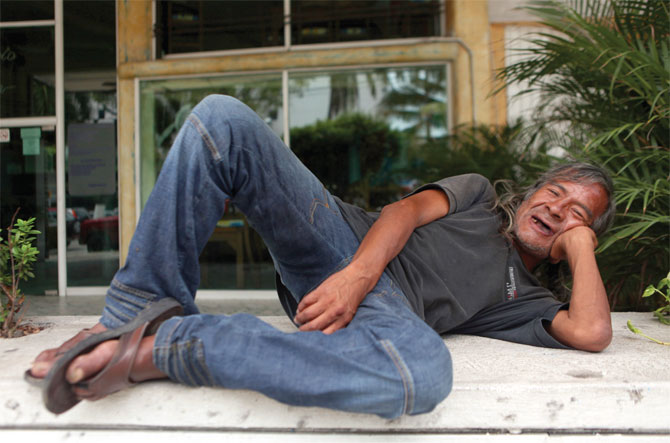
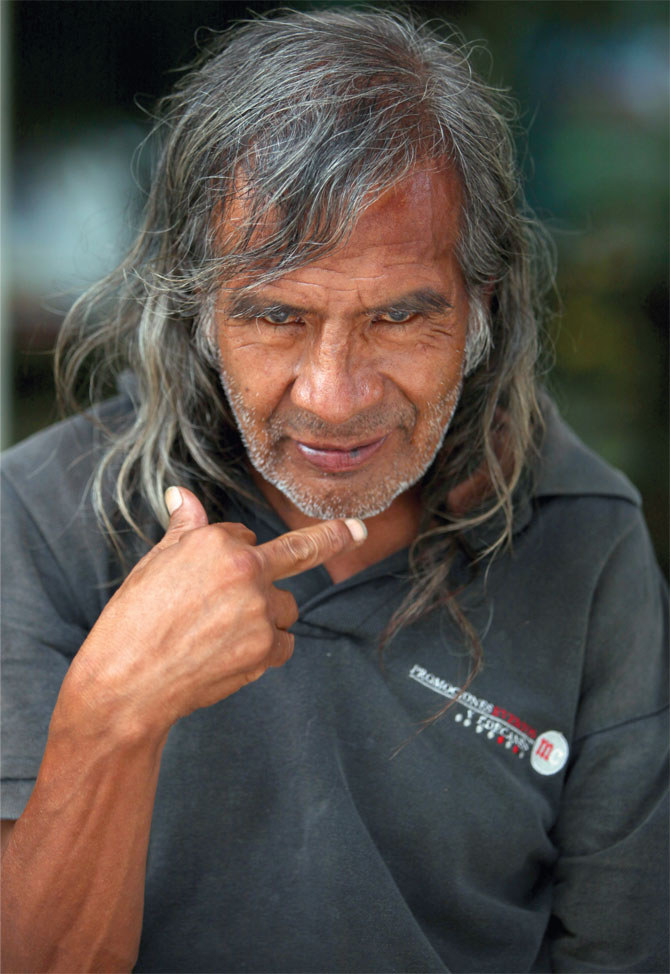 Changoleón, in the flesh.
In a megalopolis teeming with bums, freeloaders, crazies, mooches, and free spirits, the man known as Changoleón may be Mexico City’s most notable vagabond. The strange thing is that many of his fans think he’s dead. Then there are those who know the facts, most of whom would rather Changoleón stay a famous corpse than deal with the messier realities of his life. This confusion is a result of a sad and bizarre series of events that were set into motion by what is perhaps truth’s greatest enemy: reality television.
Ten years ago, Changoleón (“Monkey-lion”) was just another aging, homeless alcoholic, aimlessly wandering the streets of Mexico City’s Coyoacán neighborhood. Earlier in his life, when he was known as Samuel Gonzalez Quiroz, things seemed to be going well for the young man. He attended the National Autonomous University of Mexico, the country’s largest, and had his sights set on a career in psychology and starting a family. Then something (no one knows for sure because Changoleón’s backstory changes depending on who’s telling it) went terribly wrong, and he spent the next few decades drinking and living hard.
In 2002, Changoleón’s life changed forever. An up-and-coming comedian and television host named Facundo Gómez Brueda discovered him on the street and realized the unfortunate homeless man’s raw, drunken comic potential. The next thing Changoleón knew, he was featured on Facundo’s new late-night sketch comedy show, Toma Libre (Film Whatever, which aired on Televisa until 2004). “My name is Samuel Gonzalez Quiroz, alias the Monkey-lion!” Changoleón blubbered as he introduced himself during his first TV appearance. Soon he was a Mexican media sensation. His fame expanded when, a few years later, Facundo moved to a more mainstream prime-time comedy show called Incógnito and brought his dopey foil along for the ride. Changoleón was a TV executive’s dream: Kids loved him, the coveted 18-to-35-year-old demographic idolized him, and older folks found him scandalously amusing.
The beloved Changoleón reached the height of his popularity in the first months of 2006. Every Mexican with a TV recognized the shriveled-looking man with stringy gray hair, floppy clothes, and an enormous gap in his front teeth. He was over 60, but his perpetual drunkenness gave him a childlike energy. With the cameras rolling and “The Lion Sleeps Tonight” playing in the background, he would drink, sing, flirt with attractive girls, and practice lopsided martial-arts moves, all while muttering unscripted non sequiturs with a lisp.
At the time, this brand of spontaneous, on-the-street comedy was already tame by American standards, but Mexicans were just beginning to get acquainted with reality TV. In an entertainment landscape dominated by telenovelas, soccer, and corny slapstick comedy, the idea of a TV show that mimicked real life was shocking. When the Mexican edition of Big Brother first aired in 2002, viewers were scandalized by the idea of the cast being filmed 24 hours a day. Facundo was the first person to bring “reality” comedy to Mexico. His skits included convincing girls to take their clothes off in public parks, sending kids to ask strangers on the street why they were fat, and crashing debauched spring-break parties. Facundo became the Mexican equivalent of Tom Green, Johnny Knoxville, and Howard Stern, all rolled into one. But Changoleón’s segments were the only truly unscripted parts of Incógnito, and many people considered him the real star of the show. Facundo had effectively transformed a forgotten and left-for-dead vagrant into the country’s first reality TV star.
Changoleón had accomplished something many people desired but few managed: He got famous. And he did it with no planning or ambition. Then suddenly, in March 2006, he stopped appearing on Incógnito without explanation. Two months later, on May 1, Carlos Loret de Mola, one of Mexico’s most respected news anchors, announced to Primero Noticias’s national audience that Changoleón had died of a heart attack. Facundo later confirmed the news, adding, “He died last Sunday from a cardiac arrest; he had diabetes, hypertension, and was old.”
Over the next few days, the story took off, and Mexico’s major newspapers ran obituaries for Samuel Gonzalez Quiroz. One memorialized him as “the classic character who came out of one of the most popular neighborhoods of any city in the world; the other side of the coin from what we’re accustomed to seeing on TV. He was the indigent who lost work, family, and dignity because of drink.” Laments and good-byes popped up on blogs across Mexico. On May 3, during an episode of Incógnito, Facundo clarified Changoleón’s mysterious disappearance from the show a month and a half earlier by explaining that he had enrolled in a treatment program at an alcoholism-rehab center, but that he had left the clinic just before his death.
Then things took an absurd twist. The day after Facundo confirmed Changoleón’s death on Incógnito, Mexico City’s Forensic Medical Service announced that they had not received any cadavers matching Changoleón’s description. Even more troubling, the city’s attorney general stated that no corpses had even been recovered from the neighborhood in question on the day of his supposed death.
The following night on Incógnito, Facundo reversed his story. He said that, in fact, Changoleón had not died and that he would reappear on the show at a later date. He promised to reveal the details but only spent a few seconds explaining the convoluted situation, adding that Televisa, Mexico’s television behemoth, had been paying for Changoleón’s treatment at an alcoholism rehab center. Facundo said that when he and his Televisa colleagues had gone to retrieve their star, they were denied access to the center. He concluded by claiming that Changoleón had escaped rehab and returned to the streets to die in a more familiar setting.
In the days following this announcement, some newspapers reported that Changoleón was still alive but no one had enough facts to completely explain the confusion. Without more clarification from Televisa, the story didn’t stick, and most Mexicans were left thinking they had lost their most cherished bum.
As an American who had recently arrived in Mexico City, I first heard of Changoleón last Halloween. Some friends and I went to the main plaza of Coyoacán. Walking through the costumed crowds, my friends suddenly shouted, “Take a picture! Take a picture! It’s Changoleón! I can’t believe it!” All I saw was a little man with an unkempt gray beard and a Mickey Mouse sweatshirt marked with a huge wet spot. I couldn’t tell whether the excited knot of people surrounding him were laughing or trying to help as he staggered and grimaced. “I thought he was dead,” someone said. I took a picture and we kept moving.
I didn’t think much of it at the time, but the more I learned about Changoleón the more I wanted to find him again to ask what had happened. Did he take his money and just walk away? Did he become too much to handle for Televisa? Was it a “fuck you” to the TV big shots, or did they use him and then throw him back into the alley? Nobody seemed to know, and so I set out to find the Monkey-lion myself.
It took almost a month for me and a few Mexican friends I had enlisted to track down Changoleón. Online searches were no help. Most people said he had kicked the bucket, while others reported random sightings: “I ran into him at the Hidalgo metro station with a dude carrying a guitar,” “I saw him at the Taxqueña bus depot,” “He was at a bar in Acapulco, and my friend took a picture,” etc. Useless.
All we really knew was that he supposedly still lived in Coyoacán and he was alive, or at least he was last Halloween. All the crafts sellers, car washers, and busboys on the plaza knew him, but no one had seen him recently. Some people said he hung out and drank in front of a gym. Others told us he could be found in a nearby park. Someone else directed us to the food market. But wherever we went, the shopkeepers would tell us that he hadn’t been there for a week, two weeks, a month. Finally a man who sold handmade jewelry and tie-dyed t-shirts in the crafts market said he knew where Changoleón lived. He said that he was a friend of Changoleón’s, and I believed him: He had the same monkeyish stature, stringy gray hair, and looked to be about 60 years old. After a lot of cajoling and offers to buy him beer, he told us that Changoleón was at home and that he would take us there later that afternoon.
After the author finally tracked down Changoleón, we tried to set up a portrait shoot, but the Monkey-lion was nowhere to be found. Three rumor-filled months later we were fairly sure he was working at a bar in Acapulco. We immediately sent a photographer, who found him within 15 minutes. Changoleón happily mugged for the camera and goofed around like we were filming an episode of Incógnito.
Three blocks from Coyoacán’s main plaza, we found Changoleón’s abode. He lived off a dirt driveway in a little room in a house owned by a guy known as Don Antoño, who told us to come back with 150 pesos and a few things from the corner store: three Modelo Especiales, a liter of Alpura milk, powdered hot chocolate, and a packet of “Concha” pastries. On the way to the store, we imagined Changoleón pouring the powdered chocolate directly into his mouth, followed by the milk, and then the beer. The Monkey-lion was waiting in the driveway when we came back. He was even shorter than I remembered, and wore a baggy blue windbreaker, dirty blue jeans, and black sneakers. He was beardless but stubbly, his hair pulled into a ponytail. He greeted us with mumbles and a grin before inviting us inside.
We sat on a large bed that took up most of the room. Against one wall was a huge cabinet with glass doors filled with seashells and coral. The rest of the space was filled with piles of CDs—Mexican pop, Ricky Martin, salsa—some architecture books, and a large black refrigerator that looked at least 20 years old. The TV was playing some nondescript 90s horror movie. In one corner hung a gray suit with a pink tie.
“Nice clothes, eh?” Changoleón said before explaining that they were gifts from a certain television prankster. “Facundo told me, ‘You raised my ratings, I gave you clothes.’ He gave me some office clothes. The pants I’m wearing, too. I even put on three pairs because of the cold. Then I go out with the punks.” While we talked, Changoleón occasionally occupied himself with picking bits of lint off the bed. I noticed that he was missing half of his left middle finger.
Later, Changoleón recalled an incident in Acapulco. “One time I went over to the Fiesta Palace… no, wait… I think it’s in the Paradise Hotel… whatever, I don’t remember. Anyway, in this restaurant I was with these guys and these girls, and they start gossiping: ‘Hey, it’s the Coyoacán gang! The guy who works with Facundo—but really Facundo works for him!’” Even Facundo, whom I later interviewed for this article, agreed that Changoleón had been the real star of the show.
Listening to my recorded chat with Changoleón the next day, I realized that over the course of an hour and a half I had asked him five questions about his experience with Televisa and he hadn't answered any of them. He was an incurable babbler. He would start a sentence, then halfway through it switch to recounting some unrelated episode that had taken place ten years earlier. Either he thought we had come to hear him tell disjointed stories about his life or he had no idea what he was saying. I did, however, learn some things about the man he was before he adopted his current moniker.
Samuel Gonzalez Quiroz was most likely born in 1941—he doesn’t know his exact birthday—and according to his own account is a Coyoacán native. His parents were poor evangelicals; his mother sold sweets and candies on the street, and his father was a bricklayer who woke up at the crack of dawn every morning. One morning during his childhood, he was standing on a corner near his home with his mother, who was working. Suddenly an ambulance approached his family’s house. A group of men emerged from the ambulance and told his mother that his father had been killed in a car accident on his way to work.
Samuel was drinking and smoking regularly by age seven, but after the death of his father, Samuel’s mom, who was illiterate, made certain he attended school every day. He stuck to it, graduated high school, and was eventually accepted into the psychology program at the National Autonomous University of Mexico (UNAM), one of the biggest universities in Latin America. Mostly he remembers being surrounded by middle-class kids and attractive girls, and having a distaste for taking notes. But he enjoyed reading, and the Mexican friends who had come with me to help translate the interview said that he was very articulate in his own rambling, disjointed way.
After graduation, he took an internship at a mental institution. It seems that it left a lasting—and disturbing—impression. Some of the patients thought they were presidents or members of the petit bourgeoisie or the king of Spain, and then there were those who screamed “Don’t touch me!” when anyone approached them. The staff hid pills in the cafeteria food, and inmates received electric shocks to their testicles. Samuel had originally studied psychology with the intention of helping the poor, and planned to charge little for his services. His experience at the hospital, however, may have turned him off the entire profession. Not once did he mention going into practice.
After this chapter of Samuel’s life, the chronology gets murky. At one point he had a wife, or at least a female partner, with whom he had three children. As near as anyone knows, something went horribly wrong with this arrangement, and he began drinking in earnest. Facundo told me that Samuel sometimes implied he had been devastated by the sudden death of his mother while he was away from home, and that this was why he turned to the bottle. But no one knows exactly when or how this happened, and Facundo doesn’t consider this story to be completely true: “He’s told me a thousand different things, so who knows.”
A bit more flotsam and jetsam from Samuel’s former life surfaced during our discussion: He spent a lot of time hanging out with small-time gangs who sold drugs on the UNAM campus, joined a squatters’ collective, demonstrated with socialist groups, slept on the beach at Acapulco one night and nearly drowned, and ran with Mexico City’s biker gangs, among other random adventures. At one point, he kept a house on the outskirts of the city, by the highway to Cuernavaca, but he usually got too drunk in Coyoacán to even attempt to make it home. Eventually he gave up the house and took to living on the streets of Coyoacán, where he fell in with a band of other drunks and street people, who apparently gave him his famous nickname.
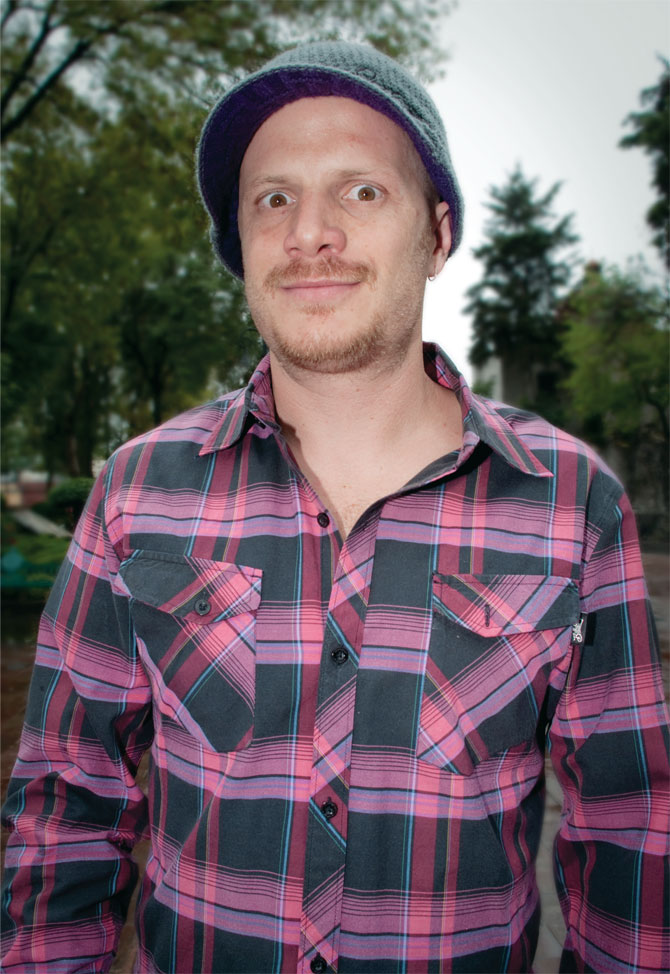
Facundo, discoverer of Changoleón and Mexico’s gateway to the weird world of “reality” comedy. Photo by Abelardo Martin
Part of Changoleón’s comic appeal was that he was the epitome of Mexico City’s lower classes and street people. Audiences loved watching Facundo’s sarcastic rich-kid persona slumming it with the happy hobo. Ironically, Changoleón is more educated than his discoverer, who proudly announces on his Facebook page that he dropped out of college before finishing a degree in music, and that he got mediocre grades in high school.
Facundo is unusually pale by Mexican standards, with a thinning blond buzz cut and perpetual stubble. A Mexico City native, he was born in 1978 to Argentine parents. After playing in bands in his teens, he started hosting Mexican music shows for the TV channel Telehit before he was 20. Soon he got a gig at Televisa hosting Toma Libre. At first I had trouble tracking down Facundo but finally reached him after an old acquaintance of his gave me a direct email. Facundo called me back almost immediately, apparently eager to give his side of the story.
One thing Facundo and Changoleón agree on is how they first met. Facundo told me that the camera was rolling when he first laid eyes on Changoleón. The Toma Libre team had recently come up with an idea for a new segment in which they would find unusual people on the street and film them—“to show something of their life,” Facundo said.
Changoleón’s recollection is that Facundo frequently came to Coyoacán’s main square to buy a strawberry smoothie from a particular store, and he happened to be hanging out there when Facundo first spotted him. Facundo asked Changoleón if he wanted to take a ride in the Televisa van, meet some chicks, and have a good time. Changoleón remembers the two girls. He told them he was going to buy drinks for everyone. They weren’t convinced. But then, as he remembers, Facundo stepped in. “It’s true,” Changoleón said. “I’m paying him now and he’s going to buy all the drinks.”
When I first watched a video of Changoleón’s debut television appearance I had the notion that—even if this was the pair’s first encounter—there was no way to tell if Facundo fed him a swimming pool of booze before taping or if he was hammered when the crew arrived. But the two girls are there in the episode. The four of them joke around, Changoleón sings drunkenly to a frightened child, and then he stumbles through a playground with a cigarette dangling from his mouth.
Facundo was thrilled with the results, and the format was set for the new “Changoleón” segment on Toma Libre: Changoleón in elementary school. Changoleón at the amusement park. Changoleón riding around the city in a convertible with a megaphone, accompanied by a woman with large breast implants. Changoleón getting a facial. Always drunk, lisping, and mumbling. A-wimoweh, a-wimoweh.
Facundo told me that Changoleón received nothing but positive feedback from the audience. “According to the emails and other things we got,” he said, “people thought, how cool that we’ve kept in mind a guy who’s excluded from society, and that we proved to people that even the homeless have something interesting to show the world.” But even in the beginning, there were lots of problems. Facundo initially tried to integrate Changoleón into the show as a scripted character and gave him a few pages’ worth of lines. When Changoleón showed up for filming, he hadn’t memorized his part. “Get out your script,” Facundo said. Changoleón didn’t have it. Facundo rolled with it. “How about this?” he said. “You just mumble, without really saying anything.”
There was also the issue of how to do business with Changoleón. Televisa never offered him a contract, although at first they tried to give him a salary. He’d spend all of it in a day, buying endless rounds of drinks for himself and his friends. This wasn’t working, so Televisa changed the plan. Facundo told me they gave Changoleón a little bit of money so that he didn’t feel like he was working for nothing, and in addition they set up an exchange with a local restaurant where Changoleón could eat and drink as much as he wanted, whenever he wanted. Facundo felt good about the deal. Before, Changoleón would get drunk on terrible five-peso wine. Now he could drink quality beer. It also solved the Toma Libre team’s problem of where to find the nomadic Monkey-lion, ensuring that their star would always be at the same place, belly full and slaphappy.
Changoleón, however, wasn’t just providing popular entertainment. He was changing the way people in Mexico thought of fame. In an online meet-and-greet in 2005, a fan called “polanco” (the name of one of Mexico City’s swankiest neighborhoods) asked Facundo how he could land a spot on TV. “i kan do the same stupid shit as Changoleón,” he wrote during the online chat. “and plus i havent showerd in like 3 dayz… hahaha.” Facundo replied: “Lose a few teeth and then you’ll get it haha,” before taking a more cautious tone: “no but Changoleón is already really popular. Not just any dood who does stupid shit deserves his spot, not even me.”
The Monkey-lion represented a very specific part of society, one that everyone who watched Incógnito recognized. Every neighborhood in Mexico City has its own Changoleón, a shaggy, drunk, and gap-toothed jokester. Some of them are called Changoleón, too. In fact, the best known of Changoleóns—Samuel Gonzalez Quiroz—received his nickname from another Changoleón. One night Samuel spotted a guy in a Coyoacán band who was very short, with curly hair and a beard. Samuel shouted, “El chango-leon!” Then the short guy in the band said, “No, you’re the Changoleón!” This went back and forth, until at one point everyone in the group was a Changoleón. But the name stuck with Samuel because, as his friend Gerardo (the man who took us to Changoleón’s house—he wouldn’t give his full name) put it, “He’s a little monkey who thinks he’s a lion.”
Facundo insists that Televisa had nothing to do with the rumor of Changoleón’s death. Around March 2006, he told me, Changoleón suddenly decided to quit drinking. The Incógnito team tried filming a few “sober” episodes with him, but it was soon clear that his comedic value was inextricably linked to the consumption of booze. Facundo didn’t want to drop Changoleón, though. So when Changoleón found it hard to stay sober and asked for help, Facundo convinced Televisa to pay for his rehabilitation and the Monkey-lion left the show.
“We didn’t want to motivate him to keep drinking just because it was entertaining,” Facundo told me. “It seemed like it would be cool if we paid for the clinic and all of his rehabilitation, instead of him going to some asshole clinic where they would have bad food and treat him badly. So that’s how we thought of doing the series about Changoleón’s rehabilitation.” If his star wanted to stop drinking, start working, and reintegrate himself into society, Facundo wanted to make it into reality TV. He realized he could turn the old bum from a comic hero into a moral one.
Changoleón would’ve done well to send this sentiment to more than a few people in his lifetime.
Soon after Changoleón entered the clinic, an entertainment-gossip magazine interviewed Facundo and asked him whether Changoleón had in fact died, since he was no longer appearing on Incógnito. Facundo said he didn’t know, because he had just left him at the clinic. So he returned to the rehab center, intending to continue filming his reality series about Changoleón’s rehabilitation. The staff denied the crew’s entrance; only family members were permitted to visit. Facundo was forced to tell the magazine that he couldn’t confirm Changoleón’s status because the clinic wouldn’t let him in. According to Facundo, this was the beginning of the rumor that Changoleón was no more.
Facundo returned to the clinic a few days later with a lawyer. The pair talked their way into the rehab center by explaining that they were effectively Changoleón’s family—he didn’t have any other relatives, and they were the ones paying for his treatment. Finally permitted to enter, they found Changoleón alive and well. Facundo tried to dispel the rumors about his death, but by this point they had already reached the national news.
When Changoleón was released from treatment, he returned to the house of a Televisa associate where he had been staying before the clinic, his rent paid by the TV company. Things almost immediately went to shit. Fernando returned from a trip out of town to find the house full of people and at least one stray dog, the furniture wrecked, and an extremely drunk Changoleón, who was promptly homeless once again.
Facundo told me that throughout the chaos, he had been planning to continue supporting and working with Changoleón. He had even convinced Televisa to continue paying for the old man to eat at the restaurant in Coyoacán, but now the idea of a reality series about Changoleón triumphing over alcoholism and returning to work and society seemed hopeless. When I asked Facundo whether he felt that Changoleón had abandoned him and TV, he said no. “The program ended and that was it. We couldn’t do anything else.” Incógnito would last until December 2006, when it had a brief hiatus and was revamped into a slightly more serious show (minus Changoleón, of course). This iteration didn’t last long.
During my time with Changoleón, he never suggested that he went to rehab voluntarily. He recounts getting drunk on the street outside the Televisa offices one day and being found by Incógnito cast members. They asked him what he was doing there. “Take a look,” he said. “Not much.”
The next thing he knew, he was in a car with Fernando. Changoleón spent several disoriented weeks in an addiction-treatment center. Workers convinced him that he had been living his life as a “dead man,” spending all his money on booze, oblivious to society. While he was in the center, he was completely unaware of the story of his supposed death. After a month, he was released. “So the day to leave comes,” he told me. “And as soon as I get out of the AA place—flash, flash! What’s going on?” He was immediately surrounded by reporters asking questions, taking pictures, and filming. “What happened?” they asked. “You’re not dead? Were you just MIA?”
The first thing Changoleón did after being picked up from the rehab center was get drunk on the car ride home. Two days later, a friend asked if he wanted a ride to Puebla, a few hours’ drive from Mexico City. Changoleón agreed. But when they got to Puebla, he realized where they were going: another rehab center. As soon as he got out of the car, he ran. He came across a bike-repair shop whose owner let him hide inside until his friends stopped looking for him. He was done with rehab and show business.
A third, more sinister explanation of the events surrounding Changoleón’s faux death was recounted to me by his friends. Many of them said that Changoleón was too real for Mexican TV, that he upset the social balance. One friend compared him to Cantinflas, the Mexican comic star of the 1940s and 50s—a poor nobody, a man of the people who babbled his way out of sticky situations. But there was one very important difference: Cantinflas’s character relied on a costume and makeup. Changoleón was just himself, Samuel the Monkey-lion.
In March 2006, this story goes, the production team at Televisa realized that the “Changoleón character” wasn’t just a source of criticism. He was a threat to their entire system. But what to do with him posed a dilemma. Without a contract, they could not simply fire him. Even more important, taking the “character” off the show would not get rid of Changoleón in real life. The logical approach was to put him in rehab in an attempt to make him a functioning member of society. Following this line of reasoning, they could feed a story to Primero Noticias (also a Televisa production) about Changoleón’s death.
No one anticipated the kind of media frenzy Changoleón’s supposed passing would unleash. When his body never appeared and the story of his death started to unravel, his friends implied—and I believe—that Televisa had to come up with a new explanation for his absence. In a stroke of luck, Changoleón seemed to supply it himself by sabotaging the second attempt to put him into rehab. Despite their best efforts to help him, Facundo could explain, Changoleón had escaped from rehab and returned to the streets to drink himself to death. Maybe they hoped he really would. At the least, they hoped people would believe it. After all, that was the logical, socially acceptable end for an unreformed drunk. Not fame, not his own show, not girls—just anonymous expiration.
The truth is probably some tangle of all three stories that will never get sorted out. When I asked Facundo why Changoleón’s friends would think that Televisa wanted to get rid of Samuel’s character, he dismissed them as opportunistic bums. “I only met one of Changoleón’s friends,” he told me. “El Vikingo, who wanted to act as Changoleón’s manager. Everyone wanted to take advantage of the ride Changoleón was on. We had to tell them, ‘Look, man, our deal is with Changoleón, nobody else.’ But they were really anti-Televisa, too.”
In some ways, Changoleón is just as famous as ever. His friends told us that his life has not returned to normal since he retired from TV. Everywhere he goes, people buy him drinks and food and pay to get their pictures taken with him. The man whose house he lives in, Don Antoño, lets him stay for free. A few times a month, he sends Changoleón to clean some houses he rents.
Changoleón told me that he had decided it was better that he stay away from TV. “I don’t really miss it,” he said. “Even though you eat good, you have to hang out with all those people who stick their pinky out when they’re drinking… No, but I don’t have anything against them. They’ve got their rights because they earn their money with the sweat of their brow.” He said he’s found various other ways to make money over the years, from selling Tibetan jewelry on the street to charging people for photos, and is happier doing this than he was working for Televisa.
Changoleón also told me that he doesn’t depend on alcohol and drugs anymore, but then added that the milk and powdered chocolate he had requested were ingredients for his personal hangover cure. “When I was a kid we had cows,” he explained. “I’d grab my stool and sit down with the bucket… and the tits… what’re they called…. the udders… and you could drink the milk. Deluxe.”
Changoleón, in the flesh.
In a megalopolis teeming with bums, freeloaders, crazies, mooches, and free spirits, the man known as Changoleón may be Mexico City’s most notable vagabond. The strange thing is that many of his fans think he’s dead. Then there are those who know the facts, most of whom would rather Changoleón stay a famous corpse than deal with the messier realities of his life. This confusion is a result of a sad and bizarre series of events that were set into motion by what is perhaps truth’s greatest enemy: reality television.
Ten years ago, Changoleón (“Monkey-lion”) was just another aging, homeless alcoholic, aimlessly wandering the streets of Mexico City’s Coyoacán neighborhood. Earlier in his life, when he was known as Samuel Gonzalez Quiroz, things seemed to be going well for the young man. He attended the National Autonomous University of Mexico, the country’s largest, and had his sights set on a career in psychology and starting a family. Then something (no one knows for sure because Changoleón’s backstory changes depending on who’s telling it) went terribly wrong, and he spent the next few decades drinking and living hard.
In 2002, Changoleón’s life changed forever. An up-and-coming comedian and television host named Facundo Gómez Brueda discovered him on the street and realized the unfortunate homeless man’s raw, drunken comic potential. The next thing Changoleón knew, he was featured on Facundo’s new late-night sketch comedy show, Toma Libre (Film Whatever, which aired on Televisa until 2004). “My name is Samuel Gonzalez Quiroz, alias the Monkey-lion!” Changoleón blubbered as he introduced himself during his first TV appearance. Soon he was a Mexican media sensation. His fame expanded when, a few years later, Facundo moved to a more mainstream prime-time comedy show called Incógnito and brought his dopey foil along for the ride. Changoleón was a TV executive’s dream: Kids loved him, the coveted 18-to-35-year-old demographic idolized him, and older folks found him scandalously amusing.
The beloved Changoleón reached the height of his popularity in the first months of 2006. Every Mexican with a TV recognized the shriveled-looking man with stringy gray hair, floppy clothes, and an enormous gap in his front teeth. He was over 60, but his perpetual drunkenness gave him a childlike energy. With the cameras rolling and “The Lion Sleeps Tonight” playing in the background, he would drink, sing, flirt with attractive girls, and practice lopsided martial-arts moves, all while muttering unscripted non sequiturs with a lisp.
At the time, this brand of spontaneous, on-the-street comedy was already tame by American standards, but Mexicans were just beginning to get acquainted with reality TV. In an entertainment landscape dominated by telenovelas, soccer, and corny slapstick comedy, the idea of a TV show that mimicked real life was shocking. When the Mexican edition of Big Brother first aired in 2002, viewers were scandalized by the idea of the cast being filmed 24 hours a day. Facundo was the first person to bring “reality” comedy to Mexico. His skits included convincing girls to take their clothes off in public parks, sending kids to ask strangers on the street why they were fat, and crashing debauched spring-break parties. Facundo became the Mexican equivalent of Tom Green, Johnny Knoxville, and Howard Stern, all rolled into one. But Changoleón’s segments were the only truly unscripted parts of Incógnito, and many people considered him the real star of the show. Facundo had effectively transformed a forgotten and left-for-dead vagrant into the country’s first reality TV star.
Changoleón had accomplished something many people desired but few managed: He got famous. And he did it with no planning or ambition. Then suddenly, in March 2006, he stopped appearing on Incógnito without explanation. Two months later, on May 1, Carlos Loret de Mola, one of Mexico’s most respected news anchors, announced to Primero Noticias’s national audience that Changoleón had died of a heart attack. Facundo later confirmed the news, adding, “He died last Sunday from a cardiac arrest; he had diabetes, hypertension, and was old.”
Over the next few days, the story took off, and Mexico’s major newspapers ran obituaries for Samuel Gonzalez Quiroz. One memorialized him as “the classic character who came out of one of the most popular neighborhoods of any city in the world; the other side of the coin from what we’re accustomed to seeing on TV. He was the indigent who lost work, family, and dignity because of drink.” Laments and good-byes popped up on blogs across Mexico. On May 3, during an episode of Incógnito, Facundo clarified Changoleón’s mysterious disappearance from the show a month and a half earlier by explaining that he had enrolled in a treatment program at an alcoholism-rehab center, but that he had left the clinic just before his death.
Then things took an absurd twist. The day after Facundo confirmed Changoleón’s death on Incógnito, Mexico City’s Forensic Medical Service announced that they had not received any cadavers matching Changoleón’s description. Even more troubling, the city’s attorney general stated that no corpses had even been recovered from the neighborhood in question on the day of his supposed death.
The following night on Incógnito, Facundo reversed his story. He said that, in fact, Changoleón had not died and that he would reappear on the show at a later date. He promised to reveal the details but only spent a few seconds explaining the convoluted situation, adding that Televisa, Mexico’s television behemoth, had been paying for Changoleón’s treatment at an alcoholism rehab center. Facundo said that when he and his Televisa colleagues had gone to retrieve their star, they were denied access to the center. He concluded by claiming that Changoleón had escaped rehab and returned to the streets to die in a more familiar setting.
In the days following this announcement, some newspapers reported that Changoleón was still alive but no one had enough facts to completely explain the confusion. Without more clarification from Televisa, the story didn’t stick, and most Mexicans were left thinking they had lost their most cherished bum.
As an American who had recently arrived in Mexico City, I first heard of Changoleón last Halloween. Some friends and I went to the main plaza of Coyoacán. Walking through the costumed crowds, my friends suddenly shouted, “Take a picture! Take a picture! It’s Changoleón! I can’t believe it!” All I saw was a little man with an unkempt gray beard and a Mickey Mouse sweatshirt marked with a huge wet spot. I couldn’t tell whether the excited knot of people surrounding him were laughing or trying to help as he staggered and grimaced. “I thought he was dead,” someone said. I took a picture and we kept moving.
I didn’t think much of it at the time, but the more I learned about Changoleón the more I wanted to find him again to ask what had happened. Did he take his money and just walk away? Did he become too much to handle for Televisa? Was it a “fuck you” to the TV big shots, or did they use him and then throw him back into the alley? Nobody seemed to know, and so I set out to find the Monkey-lion myself.
It took almost a month for me and a few Mexican friends I had enlisted to track down Changoleón. Online searches were no help. Most people said he had kicked the bucket, while others reported random sightings: “I ran into him at the Hidalgo metro station with a dude carrying a guitar,” “I saw him at the Taxqueña bus depot,” “He was at a bar in Acapulco, and my friend took a picture,” etc. Useless.
All we really knew was that he supposedly still lived in Coyoacán and he was alive, or at least he was last Halloween. All the crafts sellers, car washers, and busboys on the plaza knew him, but no one had seen him recently. Some people said he hung out and drank in front of a gym. Others told us he could be found in a nearby park. Someone else directed us to the food market. But wherever we went, the shopkeepers would tell us that he hadn’t been there for a week, two weeks, a month. Finally a man who sold handmade jewelry and tie-dyed t-shirts in the crafts market said he knew where Changoleón lived. He said that he was a friend of Changoleón’s, and I believed him: He had the same monkeyish stature, stringy gray hair, and looked to be about 60 years old. After a lot of cajoling and offers to buy him beer, he told us that Changoleón was at home and that he would take us there later that afternoon.
After the author finally tracked down Changoleón, we tried to set up a portrait shoot, but the Monkey-lion was nowhere to be found. Three rumor-filled months later we were fairly sure he was working at a bar in Acapulco. We immediately sent a photographer, who found him within 15 minutes. Changoleón happily mugged for the camera and goofed around like we were filming an episode of Incógnito.
Three blocks from Coyoacán’s main plaza, we found Changoleón’s abode. He lived off a dirt driveway in a little room in a house owned by a guy known as Don Antoño, who told us to come back with 150 pesos and a few things from the corner store: three Modelo Especiales, a liter of Alpura milk, powdered hot chocolate, and a packet of “Concha” pastries. On the way to the store, we imagined Changoleón pouring the powdered chocolate directly into his mouth, followed by the milk, and then the beer. The Monkey-lion was waiting in the driveway when we came back. He was even shorter than I remembered, and wore a baggy blue windbreaker, dirty blue jeans, and black sneakers. He was beardless but stubbly, his hair pulled into a ponytail. He greeted us with mumbles and a grin before inviting us inside.
We sat on a large bed that took up most of the room. Against one wall was a huge cabinet with glass doors filled with seashells and coral. The rest of the space was filled with piles of CDs—Mexican pop, Ricky Martin, salsa—some architecture books, and a large black refrigerator that looked at least 20 years old. The TV was playing some nondescript 90s horror movie. In one corner hung a gray suit with a pink tie.
“Nice clothes, eh?” Changoleón said before explaining that they were gifts from a certain television prankster. “Facundo told me, ‘You raised my ratings, I gave you clothes.’ He gave me some office clothes. The pants I’m wearing, too. I even put on three pairs because of the cold. Then I go out with the punks.” While we talked, Changoleón occasionally occupied himself with picking bits of lint off the bed. I noticed that he was missing half of his left middle finger.
Later, Changoleón recalled an incident in Acapulco. “One time I went over to the Fiesta Palace… no, wait… I think it’s in the Paradise Hotel… whatever, I don’t remember. Anyway, in this restaurant I was with these guys and these girls, and they start gossiping: ‘Hey, it’s the Coyoacán gang! The guy who works with Facundo—but really Facundo works for him!’” Even Facundo, whom I later interviewed for this article, agreed that Changoleón had been the real star of the show.
Listening to my recorded chat with Changoleón the next day, I realized that over the course of an hour and a half I had asked him five questions about his experience with Televisa and he hadn't answered any of them. He was an incurable babbler. He would start a sentence, then halfway through it switch to recounting some unrelated episode that had taken place ten years earlier. Either he thought we had come to hear him tell disjointed stories about his life or he had no idea what he was saying. I did, however, learn some things about the man he was before he adopted his current moniker.
Samuel Gonzalez Quiroz was most likely born in 1941—he doesn’t know his exact birthday—and according to his own account is a Coyoacán native. His parents were poor evangelicals; his mother sold sweets and candies on the street, and his father was a bricklayer who woke up at the crack of dawn every morning. One morning during his childhood, he was standing on a corner near his home with his mother, who was working. Suddenly an ambulance approached his family’s house. A group of men emerged from the ambulance and told his mother that his father had been killed in a car accident on his way to work.
Samuel was drinking and smoking regularly by age seven, but after the death of his father, Samuel’s mom, who was illiterate, made certain he attended school every day. He stuck to it, graduated high school, and was eventually accepted into the psychology program at the National Autonomous University of Mexico (UNAM), one of the biggest universities in Latin America. Mostly he remembers being surrounded by middle-class kids and attractive girls, and having a distaste for taking notes. But he enjoyed reading, and the Mexican friends who had come with me to help translate the interview said that he was very articulate in his own rambling, disjointed way.
After graduation, he took an internship at a mental institution. It seems that it left a lasting—and disturbing—impression. Some of the patients thought they were presidents or members of the petit bourgeoisie or the king of Spain, and then there were those who screamed “Don’t touch me!” when anyone approached them. The staff hid pills in the cafeteria food, and inmates received electric shocks to their testicles. Samuel had originally studied psychology with the intention of helping the poor, and planned to charge little for his services. His experience at the hospital, however, may have turned him off the entire profession. Not once did he mention going into practice.
After this chapter of Samuel’s life, the chronology gets murky. At one point he had a wife, or at least a female partner, with whom he had three children. As near as anyone knows, something went horribly wrong with this arrangement, and he began drinking in earnest. Facundo told me that Samuel sometimes implied he had been devastated by the sudden death of his mother while he was away from home, and that this was why he turned to the bottle. But no one knows exactly when or how this happened, and Facundo doesn’t consider this story to be completely true: “He’s told me a thousand different things, so who knows.”
A bit more flotsam and jetsam from Samuel’s former life surfaced during our discussion: He spent a lot of time hanging out with small-time gangs who sold drugs on the UNAM campus, joined a squatters’ collective, demonstrated with socialist groups, slept on the beach at Acapulco one night and nearly drowned, and ran with Mexico City’s biker gangs, among other random adventures. At one point, he kept a house on the outskirts of the city, by the highway to Cuernavaca, but he usually got too drunk in Coyoacán to even attempt to make it home. Eventually he gave up the house and took to living on the streets of Coyoacán, where he fell in with a band of other drunks and street people, who apparently gave him his famous nickname.
Facundo, discoverer of Changoleón and Mexico’s gateway to the weird world of “reality” comedy. Photo by Abelardo Martin
Part of Changoleón’s comic appeal was that he was the epitome of Mexico City’s lower classes and street people. Audiences loved watching Facundo’s sarcastic rich-kid persona slumming it with the happy hobo. Ironically, Changoleón is more educated than his discoverer, who proudly announces on his Facebook page that he dropped out of college before finishing a degree in music, and that he got mediocre grades in high school.
Facundo is unusually pale by Mexican standards, with a thinning blond buzz cut and perpetual stubble. A Mexico City native, he was born in 1978 to Argentine parents. After playing in bands in his teens, he started hosting Mexican music shows for the TV channel Telehit before he was 20. Soon he got a gig at Televisa hosting Toma Libre. At first I had trouble tracking down Facundo but finally reached him after an old acquaintance of his gave me a direct email. Facundo called me back almost immediately, apparently eager to give his side of the story.
One thing Facundo and Changoleón agree on is how they first met. Facundo told me that the camera was rolling when he first laid eyes on Changoleón. The Toma Libre team had recently come up with an idea for a new segment in which they would find unusual people on the street and film them—“to show something of their life,” Facundo said.
Changoleón’s recollection is that Facundo frequently came to Coyoacán’s main square to buy a strawberry smoothie from a particular store, and he happened to be hanging out there when Facundo first spotted him. Facundo asked Changoleón if he wanted to take a ride in the Televisa van, meet some chicks, and have a good time. Changoleón remembers the two girls. He told them he was going to buy drinks for everyone. They weren’t convinced. But then, as he remembers, Facundo stepped in. “It’s true,” Changoleón said. “I’m paying him now and he’s going to buy all the drinks.”
When I first watched a video of Changoleón’s debut television appearance I had the notion that—even if this was the pair’s first encounter—there was no way to tell if Facundo fed him a swimming pool of booze before taping or if he was hammered when the crew arrived. But the two girls are there in the episode. The four of them joke around, Changoleón sings drunkenly to a frightened child, and then he stumbles through a playground with a cigarette dangling from his mouth.
Facundo was thrilled with the results, and the format was set for the new “Changoleón” segment on Toma Libre: Changoleón in elementary school. Changoleón at the amusement park. Changoleón riding around the city in a convertible with a megaphone, accompanied by a woman with large breast implants. Changoleón getting a facial. Always drunk, lisping, and mumbling. A-wimoweh, a-wimoweh.
Facundo told me that Changoleón received nothing but positive feedback from the audience. “According to the emails and other things we got,” he said, “people thought, how cool that we’ve kept in mind a guy who’s excluded from society, and that we proved to people that even the homeless have something interesting to show the world.” But even in the beginning, there were lots of problems. Facundo initially tried to integrate Changoleón into the show as a scripted character and gave him a few pages’ worth of lines. When Changoleón showed up for filming, he hadn’t memorized his part. “Get out your script,” Facundo said. Changoleón didn’t have it. Facundo rolled with it. “How about this?” he said. “You just mumble, without really saying anything.”
There was also the issue of how to do business with Changoleón. Televisa never offered him a contract, although at first they tried to give him a salary. He’d spend all of it in a day, buying endless rounds of drinks for himself and his friends. This wasn’t working, so Televisa changed the plan. Facundo told me they gave Changoleón a little bit of money so that he didn’t feel like he was working for nothing, and in addition they set up an exchange with a local restaurant where Changoleón could eat and drink as much as he wanted, whenever he wanted. Facundo felt good about the deal. Before, Changoleón would get drunk on terrible five-peso wine. Now he could drink quality beer. It also solved the Toma Libre team’s problem of where to find the nomadic Monkey-lion, ensuring that their star would always be at the same place, belly full and slaphappy.
Changoleón, however, wasn’t just providing popular entertainment. He was changing the way people in Mexico thought of fame. In an online meet-and-greet in 2005, a fan called “polanco” (the name of one of Mexico City’s swankiest neighborhoods) asked Facundo how he could land a spot on TV. “i kan do the same stupid shit as Changoleón,” he wrote during the online chat. “and plus i havent showerd in like 3 dayz… hahaha.” Facundo replied: “Lose a few teeth and then you’ll get it haha,” before taking a more cautious tone: “no but Changoleón is already really popular. Not just any dood who does stupid shit deserves his spot, not even me.”
The Monkey-lion represented a very specific part of society, one that everyone who watched Incógnito recognized. Every neighborhood in Mexico City has its own Changoleón, a shaggy, drunk, and gap-toothed jokester. Some of them are called Changoleón, too. In fact, the best known of Changoleóns—Samuel Gonzalez Quiroz—received his nickname from another Changoleón. One night Samuel spotted a guy in a Coyoacán band who was very short, with curly hair and a beard. Samuel shouted, “El chango-leon!” Then the short guy in the band said, “No, you’re the Changoleón!” This went back and forth, until at one point everyone in the group was a Changoleón. But the name stuck with Samuel because, as his friend Gerardo (the man who took us to Changoleón’s house—he wouldn’t give his full name) put it, “He’s a little monkey who thinks he’s a lion.”
Facundo insists that Televisa had nothing to do with the rumor of Changoleón’s death. Around March 2006, he told me, Changoleón suddenly decided to quit drinking. The Incógnito team tried filming a few “sober” episodes with him, but it was soon clear that his comedic value was inextricably linked to the consumption of booze. Facundo didn’t want to drop Changoleón, though. So when Changoleón found it hard to stay sober and asked for help, Facundo convinced Televisa to pay for his rehabilitation and the Monkey-lion left the show.
“We didn’t want to motivate him to keep drinking just because it was entertaining,” Facundo told me. “It seemed like it would be cool if we paid for the clinic and all of his rehabilitation, instead of him going to some asshole clinic where they would have bad food and treat him badly. So that’s how we thought of doing the series about Changoleón’s rehabilitation.” If his star wanted to stop drinking, start working, and reintegrate himself into society, Facundo wanted to make it into reality TV. He realized he could turn the old bum from a comic hero into a moral one.
Changoleón would’ve done well to send this sentiment to more than a few people in his lifetime.
Soon after Changoleón entered the clinic, an entertainment-gossip magazine interviewed Facundo and asked him whether Changoleón had in fact died, since he was no longer appearing on Incógnito. Facundo said he didn’t know, because he had just left him at the clinic. So he returned to the rehab center, intending to continue filming his reality series about Changoleón’s rehabilitation. The staff denied the crew’s entrance; only family members were permitted to visit. Facundo was forced to tell the magazine that he couldn’t confirm Changoleón’s status because the clinic wouldn’t let him in. According to Facundo, this was the beginning of the rumor that Changoleón was no more.
Facundo returned to the clinic a few days later with a lawyer. The pair talked their way into the rehab center by explaining that they were effectively Changoleón’s family—he didn’t have any other relatives, and they were the ones paying for his treatment. Finally permitted to enter, they found Changoleón alive and well. Facundo tried to dispel the rumors about his death, but by this point they had already reached the national news.
When Changoleón was released from treatment, he returned to the house of a Televisa associate where he had been staying before the clinic, his rent paid by the TV company. Things almost immediately went to shit. Fernando returned from a trip out of town to find the house full of people and at least one stray dog, the furniture wrecked, and an extremely drunk Changoleón, who was promptly homeless once again.
Facundo told me that throughout the chaos, he had been planning to continue supporting and working with Changoleón. He had even convinced Televisa to continue paying for the old man to eat at the restaurant in Coyoacán, but now the idea of a reality series about Changoleón triumphing over alcoholism and returning to work and society seemed hopeless. When I asked Facundo whether he felt that Changoleón had abandoned him and TV, he said no. “The program ended and that was it. We couldn’t do anything else.” Incógnito would last until December 2006, when it had a brief hiatus and was revamped into a slightly more serious show (minus Changoleón, of course). This iteration didn’t last long.
During my time with Changoleón, he never suggested that he went to rehab voluntarily. He recounts getting drunk on the street outside the Televisa offices one day and being found by Incógnito cast members. They asked him what he was doing there. “Take a look,” he said. “Not much.”
The next thing he knew, he was in a car with Fernando. Changoleón spent several disoriented weeks in an addiction-treatment center. Workers convinced him that he had been living his life as a “dead man,” spending all his money on booze, oblivious to society. While he was in the center, he was completely unaware of the story of his supposed death. After a month, he was released. “So the day to leave comes,” he told me. “And as soon as I get out of the AA place—flash, flash! What’s going on?” He was immediately surrounded by reporters asking questions, taking pictures, and filming. “What happened?” they asked. “You’re not dead? Were you just MIA?”
The first thing Changoleón did after being picked up from the rehab center was get drunk on the car ride home. Two days later, a friend asked if he wanted a ride to Puebla, a few hours’ drive from Mexico City. Changoleón agreed. But when they got to Puebla, he realized where they were going: another rehab center. As soon as he got out of the car, he ran. He came across a bike-repair shop whose owner let him hide inside until his friends stopped looking for him. He was done with rehab and show business.
A third, more sinister explanation of the events surrounding Changoleón’s faux death was recounted to me by his friends. Many of them said that Changoleón was too real for Mexican TV, that he upset the social balance. One friend compared him to Cantinflas, the Mexican comic star of the 1940s and 50s—a poor nobody, a man of the people who babbled his way out of sticky situations. But there was one very important difference: Cantinflas’s character relied on a costume and makeup. Changoleón was just himself, Samuel the Monkey-lion.
In March 2006, this story goes, the production team at Televisa realized that the “Changoleón character” wasn’t just a source of criticism. He was a threat to their entire system. But what to do with him posed a dilemma. Without a contract, they could not simply fire him. Even more important, taking the “character” off the show would not get rid of Changoleón in real life. The logical approach was to put him in rehab in an attempt to make him a functioning member of society. Following this line of reasoning, they could feed a story to Primero Noticias (also a Televisa production) about Changoleón’s death.
No one anticipated the kind of media frenzy Changoleón’s supposed passing would unleash. When his body never appeared and the story of his death started to unravel, his friends implied—and I believe—that Televisa had to come up with a new explanation for his absence. In a stroke of luck, Changoleón seemed to supply it himself by sabotaging the second attempt to put him into rehab. Despite their best efforts to help him, Facundo could explain, Changoleón had escaped from rehab and returned to the streets to drink himself to death. Maybe they hoped he really would. At the least, they hoped people would believe it. After all, that was the logical, socially acceptable end for an unreformed drunk. Not fame, not his own show, not girls—just anonymous expiration.
The truth is probably some tangle of all three stories that will never get sorted out. When I asked Facundo why Changoleón’s friends would think that Televisa wanted to get rid of Samuel’s character, he dismissed them as opportunistic bums. “I only met one of Changoleón’s friends,” he told me. “El Vikingo, who wanted to act as Changoleón’s manager. Everyone wanted to take advantage of the ride Changoleón was on. We had to tell them, ‘Look, man, our deal is with Changoleón, nobody else.’ But they were really anti-Televisa, too.”
In some ways, Changoleón is just as famous as ever. His friends told us that his life has not returned to normal since he retired from TV. Everywhere he goes, people buy him drinks and food and pay to get their pictures taken with him. The man whose house he lives in, Don Antoño, lets him stay for free. A few times a month, he sends Changoleón to clean some houses he rents.
Changoleón told me that he had decided it was better that he stay away from TV. “I don’t really miss it,” he said. “Even though you eat good, you have to hang out with all those people who stick their pinky out when they’re drinking… No, but I don’t have anything against them. They’ve got their rights because they earn their money with the sweat of their brow.” He said he’s found various other ways to make money over the years, from selling Tibetan jewelry on the street to charging people for photos, and is happier doing this than he was working for Televisa.
Changoleón also told me that he doesn’t depend on alcohol and drugs anymore, but then added that the milk and powdered chocolate he had requested were ingredients for his personal hangover cure. “When I was a kid we had cows,” he explained. “I’d grab my stool and sit down with the bucket… and the tits… what’re they called…. the udders… and you could drink the milk. Deluxe.”