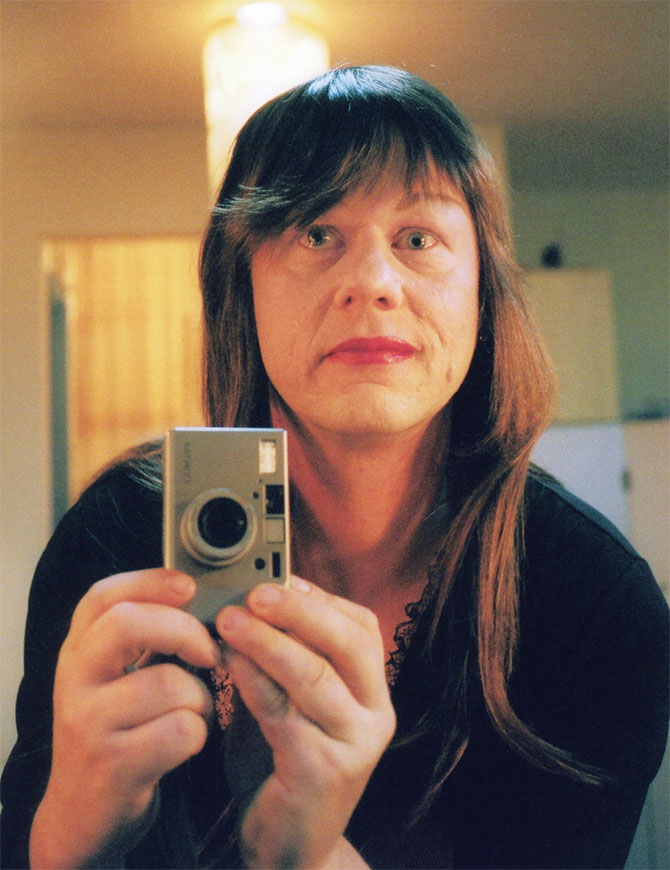
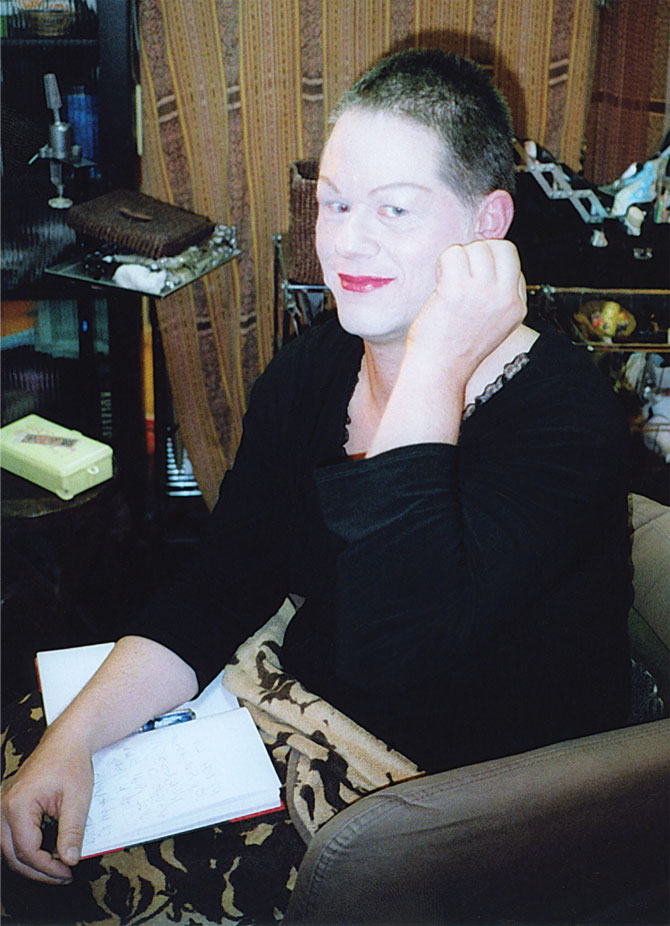
| Vollmann as a woman. |
One of the main reasons that William T. Vollmann’s writing is so expertly detailed and rich is because he is a master of both old-fashioned, shoe-leather research and the deskbound library variety. His hugely varied interests have led him to the North Magnetic Pole, war-torn Yugoslavia and Iraq, Afghanistan in the early 80s (where he was embedded with the mujahideen), through the hooker-filled Tenderloin district of San Francisco, aboard freight trains with hobos and tramps, and more. Vollmann has a genuine fascination with his subjects and locales, and his true greatness lies in his ability to repeatedly distill his obsession of the moment into a damn good read.
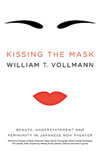
After 20 years of plugging away, Vollmann’s singular talent was officially canonized when his 2005 novel Europe Central received the National Book Award for fiction. Vice was lucky enough to publish an original short story by Vollmann in our 2007 Fiction Issue, and we now present to you an excerpt from his latest nonfiction book, Kissing the Mask: Beauty, Understatement, and Femininity in Japanese Noh Theater. As its title suggests, it is a sociological exploration of the strange, veiled world of Noh and its practitioners. The book is filled with transvestites, geishas, sex fiends of the red-light Kabukichō district, and many other interesting characters both elegant and perverted. It also marks the first time that we have read the word “neovagina.”
In the following excerpt (from chapter 16, “They Just Want to Look in the Mirror”), the author is made over by a makeup artist whose clientele includes a large number of cross-dressing Japanese businessmen. We think that Vollmann looks very becoming as a woman.
Yukiko’s salon is unmarked, naturally, and there is a discreet second-floor entrance. The street is quiet, at least for Tokyo; her clients must feel safe. The room is by my standards smallish—about the size of the chamber where Suzuka-san’s colleague geisha Kasami-san danced for me. While Yukiko makes tea, I go into the tiny lavatory to change into my new black dress.
Laying out three disks of foundation, Yukiko, who is 30ish and very pretty, with long brown hair, shows me the corresponding pictures in the Japanese fashion magazines: One foundation looks best photographed and printed onto glossy paper; one is more appropriate to going out on the street; and the third is intermediate. I choose the second.
Gandhi advises us to do what we do without expecting results; and I entertain decidedly minuscule hopes of achieving maiko-esque beauty, especially since although I carefully shaved in my hotel less than two hours before, Yukiko sweetly, reproachfully inquires whether I have shaved.
She begins with a cream-type astringent: Clarins Lotion Tonique.* The base cream will be Diorskin 001 base de teint, which contains a hint of pearl, making it a trifle shiny. The purpose is to even the skin. One adds less of it in summer, more “where it needs it more.” Yukiko begins with the Diorskin by dabbing with her forefinger a spot on my forehead, an upper and lower spot on each cheek, and a spot between my mouth and my chin. On the forehead she works the stuff horizontally, elsewhere vertically. Then she addresses the zone beneath each eye, proceeding in descending arcs from the center of the underlid out to the cheek, her touch so firm that my flesh moves. Next she rubs it on the eyelids. All the while, I must keep my eyes open.
Now it is time for the number three cream foundation. Formerly, she says, Japanese women used to lighten their faces with foundation, but at the moment they prefer to slightly darken them, making them appear smaller. Firmly patting with the sponge (she always employs a new sponge for every step), smoothing around my eyes, she instructs me to look up while staying still. After two hours my skin oil will reappear, she says. She mentions a special paper from Kyoto which can absorb it (an easy procedure: Simply pat and adjust); all the same, I am reminded how limited and ephemeral this is; and for a moment I nearly begin to comprehend the sacrificial hours paid by women at their mirrors and in beauty parlors and department stores and manicure-pedicure studios. Suzuka’s nightly effort is, as we have seen, significant—not to mention the long preparations of Mr. Umewaka in the mirror room before his Noh performances. And all of it must be done over again next time.
“You see,” says Yukiko, lightly touching my chin, “even now it is starting to show. Since your beard is not black it should be OK for a couple of hours.” As a result of such transience, her customers generally do no more than remain here with her, for about three hours. After a chat and tea, they return home to their families.
Next comes the concealer, in order to render the contour of my new age spot more vague. It is a stick cream, Anti-Cervier, Yves Saint-Laurent product number 41911-1. Yukiko also applies it to my wrinkles, and especially to the wedge of skin below and outside of each eye, using two fingers, always going up, not down, since we don’t want to show the sagging of my face.
In general, runs her diagnosis, my poor male flesh is afflicted with many red spots; her goal is to render it a uniform color. She works for quite a while on the creases between the two wings of my nose and on the corners of my mouth. With special care she rubs concealer over the age-downturned corners of my lips.
“How old can a man become and still resemble a woman?”
“After age 60 it is quite difficult.”
Following the concealer comes the powdery foundation (a white substance, Anna Sui Face Powder 700), rubbed in, first on the wrinkles around my eyes. First touching me with her brush, then rubbing with a finger, always upward, in firm strokes that move flesh, beneath each eye she creates a downpointed right triangle whose inner side parallels my nose. Yukiko can render this undercoat (the equivalent of gesso on an oil painting) either glossy for a “cute” look or else more natural so that the client appears “classical.” Suspecting that cuteness lies beyond my power, I have elected for the classical look.
I ask Yukiko how I could best approximate all this at home, and she advises me to buy a magnifying mirror.
Now for an eye shadow, which she smears gently in, selecting here and there from many different looks in the palettes, where it resembles vanilla, chocolate, and strawberry ice cream. “When you get older it gets darker under the eye, particularly for Japanese,” she informs me tactfully. “Then the eye shadow will not appear nice.” This amelioration likewise lasts for about two hours. Using a special brush, she makes seven round trips across each eyelid “like a windshield wiper.” Where the brush first touches, there it will be thickest; those round trips smooth it out. Then she proceeds upward, afterward rubbing up and down with her finger in order to blur the contours.
She warns me to avoid allowing any eye shadow to fall on my cheek, since it cannot easily be removed.
Again, the goal seems to be making the facial skin more uniform, disguising lines and color changes. If so, then the white mask-face of the geisha, or the literal mask-face of the Noh beauty, are simply farther along the continuum.
* It is not my normal practice to include brand names in my books. However, since the makeup procedures of geishas and onnagatas are described in some detail, I thought to achieve a comparable level of specificity. Moreover, since my interpreter rarely deployed makeup herself, it is possible that some unguental functions have been misunderstood in this chapter; if so, the brand names may reveal whichever errors I have made.

Now with her soft brush Yukiko mixes two kinds of purple Japanese powder. Then she bends over me, commencing beneath the center of each eye, following the cheekbone “to make it natural.” Her applications consist of circles proceeding down and away from the eye, then up back toward it. She continues until my skin appears just a trifle lighter in color than my cheeks.
Here come the many square pats of lipstick in Yukiko’s mirrored palette. She mixes a crimson and a pink. Obediently, I keep my mouth closed. With a brush she paints my lower lip larger. She seals her work with transparent gloss.
A slanted-tipped brush is good for the eyebrows. She opens the eyebrow palette.
First she brushes on powder-outlines, since mistakes can be removed without trouble; then she fills in with the eyebrow pencil. Carefully she graduates the edges. It is difficult not to make crooked eyebrows, but I must report that Yukiko has risen to the occasion.
She selects a wig. Then she invites me to study myself in the mirror; and it seems that a woman is looking back at me—not a beautiful woman, perhaps; but still, here is someone who came into the world just now and will exist more briefly than I, a woman who has feelings (my feelings); she wants to look her best. What is grace? I assuredly lack it. But I have become pleasingly alien to myself; I am other just as distinctly as misted purple-gray mountains stand out from blindingly snowy rice-fields.
What changed my appearance the most?—The wig and the lipstick, I would say; much of the other procedures simply diverted attention from the age of my skin. In this connection it is interesting to insert another claim by the zoologist Desmond Morris: Long hair and a hairless (or pale and uniform) face increase contrast, thereby making the woman more visible to potential mates. Puffed-out lips (and my made-up mouth does express the illusion of more voluminous lips) are more juvenile, hence indicative, I suppose, of fresher ova.—But then I wonder to what extent convention plays a part. Why wouldn’t Cro-Magnon men have let their hair grow as long as their women did? Besides, the Noh museum in Kanazawa displays a certain atsuita, a thick cloth robe mostly for male roles, which offers its audience a base of turtle-shell octagons, with embroidered patterns pertaining to each of the four seasons within cloud- or fan-shaped borders; it is beautiful, but why should it be male?
—And so once again I feel myself to be, as I so often do when I try to comprehend the nuances of Noh, an ape in a cage.—In Yukiko’s studio, an ape in a wig stares back at me with sad blue eyes.
I pull the wig off as carefully as I can (for some other client will surely require it), and hand it to Yukiko, remembering that Sei Shnagonō’s 11th-century list of things that have lost their power includes a woman who has removed her wig in order to comb remnants of natural hair.
Now Yukiko makes me up another way, with her hands rubbing in the cold, pleasant-smelling cleanser (harder to apply; maybe it is this that makes my skin feel so tight later), rubbing its coldness in with her hands, going over me with cotton, putting on a liquid foundation, chatting and patting—how nice to be taken care of!—my face paling in the mirror; my eyes seem to glitter more.
Only about 10 percent of her customers dare to go out. They often wear femme-executive or businesswoman outfits when they come to her; a few play with lingerie, but never here; some keep secret apartments furnished with their woman things, so that their families will never know. They tend to order clothes on the internet, a circumstance which requires them to buy repeatedly before discovering a garment which actually fits; but anonymity remains infinitely more important to them than cost or convenience.
“Why do they do it?”
“Stress,” she replies. “And they have the pleasure of hiding something secret.”
Her clients (“20 or 30”) tend to be doctors, attorneys, et cetera, since she is so expensive—$700 for three hours.
“Many of them are narcissistic,” she adds, perhaps with a touch of contempt, “so they just want to look into the mirror.”
“Do you think most men would do this if they could?”
She smiled. “Well, I believe that few men would like to do it. But some of those good-looking young male singers who are handsome in an effeminate way, maybe they would like to be like them.”
“Would you date a cross-dresser?”
“Never.”
As she works on me, I fall into a drowse, enjoying the caress of the black brush, the sound of rain outside, Yukiko standing over me. I gaze up at her chin and lips, her brown hair, her tinted eyelids. Her eyes are far away, for she is gazing not at me, but at my face, which is now halfway feminized. She is painting my eyebrows on. I open myself to her soft fingers on my temple, the silver gleam of the brush, and her fingers on my eyebrows.
“What is the most serious obstacle faced by a man who wants to pass for a woman?”
“Coarse skin.”
Now that she has finished, it is time for the excitement of the new wig (style B02, color T/430; made in Korea), of wondering what it is going to make me look like. “This one is more becoming,” she says. The hair, reddish like the first wig, is longer, “more simple,” with short bangs. “Because it shows the eyebrows it looks more feminine,” she concludes, sliding it on.
Who am I? My reddish-gold hair spills down to my breasts, so soft and golden in its highlights, matching my new eyebrows. I have pearly-pale skin—no, actually, I seem to be a rather hard-skinned woman; the creases in my face show more and more; soon my stubble will overpower the concealer; at least I possess a bright glowing smile. (Thank goodness I recently got my teeth cleaned.)
But who is this lady? Her eyes seem somehow a darker blue than mine. Is she fake? Her soft red-purple lips smile back at me. I toss my head, and her hair changes to gold.*
For an instant, and with joy, I believe in her, all the while experiencing aware, the knowledge that this impossibility cannot be sustained. (The Vimalakirti Sutra, seventh century: “This body is like a flame born of longing and desire… This body is impure, crammed with defilement and evil… This body is like the abandoned well on the hillside, old age pressing in on it. This body has no fixity, but is destined for certain death.”) This session at Yukiko’s has strangely resembled a Noh performance, and lasted approximately the same length of time.
The best mask of my self (never mind my soul) may well be a chujo; my forehead will soon begin to wrinkle in a pattern like roots, and I often bear the sparse mustache, gaping mouth, and blackened teeth of the loyal bewildered lieutenant; perhaps I belong to the Komparu school. What the artist inscribed on the back of my face I will never know, being unable to see myself objectively the way a professional Noh actor would. Most of the time I am a sturdy man who wears the same clothes often, preferring garments of lifelong reliability; I shave carelessly and shrug off my latest wrinkles, because anyhow I never possessed even a waki’s hope of being beautiful, nor felt the loss.
What is grace?—In the mirror room, Mr. Umewaka gazes at the lovely woman he will soon become; he sits white-wrapped like a man in an American barber shop, with the wig of long blue-black hair already crowning him, and in the mirror the woman of frozen-faced perfection, one of his several other selves, gazes back at him calmly and untouchably.
* Morris claims that blond hair indicates the juvenile stage for many Caucasians; hence it is desirable for many women.
![]() |
From the book KISSING THE MASK: Beauty, Understatement and Femininity in Japanese Noh Theater by William T. Vollmann. Copyright © 2010 by William T. Vollmann. To be published on April 6, 2010 by Ecco, an imprint of HarperCollins Publishers. |


Thought and Memory
New Fiction by Ed Park
Malaysian Neo-Nazis
Fighting for a Pure Malay Race
The Strongest Dwarf in New Jersey
Remembering My Tormentor
Gay Men and Their Misogyny Problem
It's Not Cute Anymore
Triple Hate - Part 1
The KKK vs. the Crips vs. Memphis City Council
Saudi Arabia's Feminist Revolution
It's Not Happening
Comments