

As a kid growing up in the ’90s, time spent with your grandparents often boiled down to running errands and sitting at home watching various daytime TV shows. Among those was The Price is Right. I would watch people struggle with various games and think, “Man, I can do that.” And then came Pachinko. And I knew I could master it. With Ballionaire, I had the chance to prove myself.
Ballionaire is a physics-based Pachinko Roguelike that makes use of various boons and triggers to help you achieve the ever-rising target score for each of the game’s levels. The hook here is that you’re expected to “break the game” with these combinations of items. All the triggers play well off of others, and it’s up to you to discover the combinations that work best.
Videos by VICE
And you’re gonna need every single small advantage you can get. As a player, your part is planning, placement, and starting the game. The physics of the bounces — or “bonks” — handles the rest. The strategy lies in where you place your triggers. You can fill the board up a decent amount. But, if your choices are off by even a little bit, you won’t maximize your run. In that case, you’re going right back to the main menu.
‘BALLIONAIRE’ MADE ME CONSIDER A NEW STYLE OF GAME
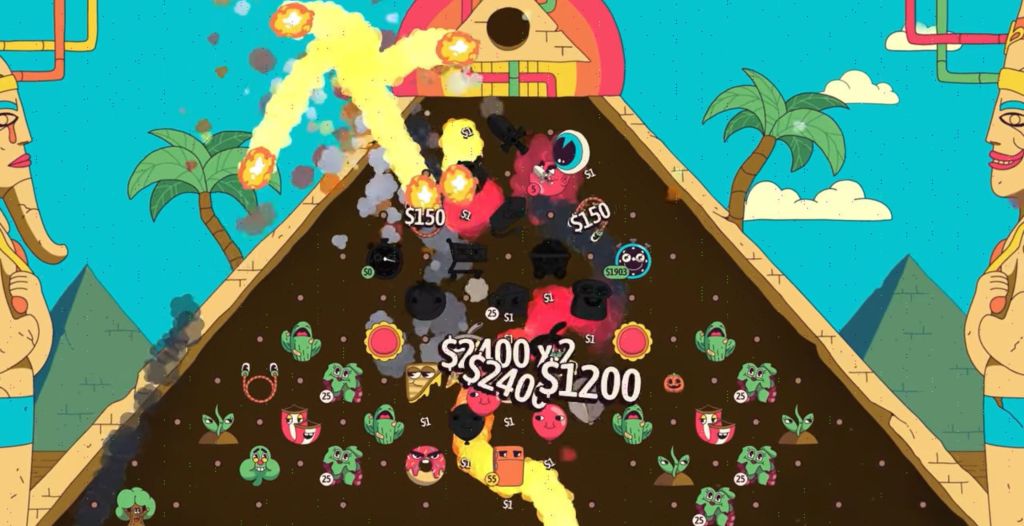
I’ll admit, I struggled a bit to get the “catch” of this game. In the same way, you may need to run an album back a few more times before you understand what the artist was going for. I eventually did, though. That being said, while I appreciated the concept, there’s something about the game that kept me from wanting to go back.
So, in my time playing, I’ve logged about 25 hours total. But it didn’t feel compulsive the way the best roguelikes do. The combinations of triggers are seemingly endless. I have to give credit for the amount of work that can go into creating the perfect run. But beyond planning and placement, I felt detached from the game.
Even my best runs felt like I didn’t really have a hand in it. But that’s the nature of the game: how well can you plot out this board and then let gravity and physics do the work? When you hit a good rhythm, it’s cool! I just don’t know if it’s enough to keep you going. The various unlocks open up the game in different ways, and they’re provided via an interesting vending machine system. It’s a great way to handle getting new triggers.
There’s SOMETHING THERE
The art style and music in Ballionaire are incredible. I can see how people could lose themselves in it. I couldn’t help but smile at many of the characters I saw in my time playing. It’s a roguelike that encourages some level of relaxation. It’s Tetris-like in that way. Unfortunately, it just didn’t grab me enough to make me feel like I had to keep playing it.
There’s a good game here, though. I truly don’t think it’s bad by any stretch. But it is one I believe falls in the “your mileage may vary” category. Some people can get hundreds of hours out of this. Some won’t. In the end, I think the concept is interesting enough to warrant giving it a shot.
VERDICT: RECOMMENDed
Ballionaire is available on PC. A review code was provided by the publisher.
More
From VICE
-

Photo: Photo Italia LLC / Getty Images -

Photo: wildpixel / Getty Images -

Photo: Igor Ustynskyy / Getty Images -

Photo: stellalevi / Getty Images
