


Photos by the author
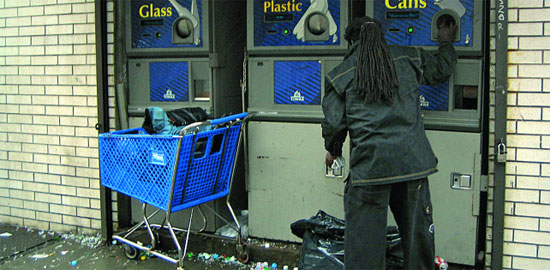
The Chinese ladies who redeem bottles and cans in the recycling machines outside Key Food on Ave. A and 3rd Street in New York’s East Village treat it like a job. They wake up early in the morning and collect recyclables in garbage bags attached to shopping carts all day, and then they redeem everything in the afternoon. A full garbage bag is worth about $10. The machines—there are three of them, plastic, glass, and aluminum—are outside, on the side of the store, where you’d see soda machines in a suburban mall. The ones at Key Food are popular because they are the only ones in the area that will redeem more than $20 worth of bottles and cans. The machines close at nightfall, so as it gets closer to dark, the Chinese ladies often get into literal fistfights over who’s next in line. It’s vicious. I saw one of these altercations and the cops had to break it up.
The machines are called Reverse Vending Machines, or RVMs, and are made by a company called Tomra that has machines worldwide. Tomra describes RVMs as “cost-effective systems that make it attractive for people to return used beverage containers,” but anyone else would describe them as machines for homeless people who pick through the trash.
The ladies are not homeless though. They live in the area. They speak Cantonese only and work alongside men who are mostly black and huge. The men aren’t menacing—one had trouble remembering street names and was kind of embarrassed and reticent. Another one had the vibe of a broken man looking for angles. The Chinese ladies keep their distance from the men. They have a whole different kind of mien: efficient, self-sufficient, quick, and tough—they laugh and yell and smile and race around and all that—a lot of them put their hair in clips—also they are all extremely little.
The way the machines work is you feed your cans into them, they keep a count, then give you a receipt that you take into Key Food to cash at the register. Once, when a woman’s receipt didn’t print (she had put in 24 cans, or $1.20), about eight black men materialized, like fairies. One man, Arturo, a gigantic man, told the lady, “You know how you get tired sometimes and you just had enough? That’s what happened to the machine. You know when you just had enough? It can’t print, you see, it can’t push down anymore, the arm … it can’t push down, that’s why. It’s too tired.” There was this whole buzz in the air—the “black ghosts” (that’s what the Chinese ladies call them) really snapped awake, like to the excitement of financial disaster.
The Chinese ladies all keep themselves tidy and assemble the same kind of look. They wear cotton patterned shirts, loose pants, aprons, and sneakers. Most of them didn’t want to talk to me, but said so politely, stopping their work to look at us and say, “Thank you, no.” It was only on the third day of hanging around with them that they got a little rude—with the “I can’t hear” and the “go away” and even a few snarls.
Hui Tang was the only woman who would talk to us. She was wearing a straw hat, a purple shirt, loose black cotton pants, a black apron, and Tevas. She had clean, chin-length hair, clear skin, no teeth, and dirty, thick fingernails. She told us that the Key Food women were not talking to us because they were afraid. She said she’s not so much friends with them because they are from Fuktor and she is from Shenzhen, and also the Key Food ladies fight too much.
She came to America on an airplane with her family in 1983. Her husband died in 1993, and she lives now with her daughter in an apartment on Ave. C and 10th that costs $494 a month. She agreed to walk us around to all the places where she gets food and cans and supplies (all of them are in the East Village), and she let us into the entryway of her apartment. She wouldn’t let us into her place, though. She said, “My daughter is crazy. She would try to kill you if you came in.” We asked her if she would take our camera in and take pictures, and she said her daughter, who is 40 and has not been married, would beat her up if she tried that.
OK, she was really cheerful, but living as she does is dangerous, of course. She has been attacked a lot. She said, “On Seventh Ave., I got beaten up by a Spanish guy. I was coming down the street and he hit me, broke my arm, and my hand swelled up. I had to go to the hospital. In the hospital, I was in a room with a fat white woman. I didn’t know how to push the button to call the nurse, so I had to hold it for a long time. Finally, I couldn’t hold it anymore, so I took my shoe and I threw it at the door and got the nurse. The nurse spoke Chinese but a different dialect, but I wrote down that I needed to piss and shit and the nurse understood.”*
Here is another story she told: “Once on Delancey in 1985 or 1986, five hoodlum Western kids came up to me. They had a pipe they were going to hit me with. I know some kung fu from China. I managed to get the pipe from the hoodlum and whacked him on the back, hurting him very seriously.” When she was telling this story, she made a yelling sound that sounded like the clanging of sheet metal, and she opened her mouth like a snake and demonstrated several fighting postures.
Not knowing English is, of course, a problem. In 1998, Hui Tang’s daughter was in the hospital, and she has the impression that her daughter was not given medicine, and she does not know why. She said, “It was a Chinese doctor. I don’t know why they wouldn’t give her medicine. They gave me a thing of milk. My daughter went crazy independently, I think, but I don’t know why they wouldn’t give her medicine. I had to go to Chinatown to get Asian medicine and make it for her. I got red flower medicine from Singapore, and boiled it up, and put it on my daughter’s temples and chest until she was trembling, saying, ‘No more, no more.’” Another time, someone tried to take her picture. She said, “My daughter said, ‘Let’s pose for their picture,’ but I didn’t because I didn’t know why they wanted a picture. I think they were probably from the government. The government is going to take my furniture.”
Hui Tang knows a lot of crazies. We passed this one friend of hers and she explained, “He is Japanese. He sleeps on 20th Street under some trees, with his friend. One night, they woke up and a crazy man was trying to steal their cans. He got up and tried to stop the man, and the man tore his clothes off and scratched him very severely, drawing blood. There are all kinds of terrible people on the streets.”
Oh, a funny thing: We passed a man holding an aluminum tray of hot dogs, and she just kind of rolled on up and stuck her nose into his food, seeing if he’d give her any. He looked at her like “go away” and she strolled back over to us—no big deal. We’d all gotten pretty touchy by now—touchy-feely—touching hands, arms, whatever. We asked her why she’d agreed to talk to us, and she said she felt sorry for us when the Key Food ladies were giving us the freeze-out.
She asked us to get dinner with her the next day, and we agreed to meet, but then never saw her.
AMIE BARRODALE WITH ADDITIONAL REPORTING BY DAWN CHAN
* Dialects are like accents, and people who speak different dialects can sort of understand each other, up to a point. But sometimes it’s like someone from the Deep South 100 years ago trying to speak to someone from Scotland today. Still, different dialects use the same alphabet, so people who can’t understand each other can communicate by writing. Hui Tang and the interpreter spoke slightly different dialects, and Hui Tang said, “If you don’t understand what I’m saying, just make something up. My spirits are lifted walking with you two.”
Videos by VICE
Περισσότερα από το VICE
-

(Photo by Mike Stobe/BIG3/Getty Images) -

(Allen J. Schaben / Los Angeles Times via Getty Images) -

(Photo by Kevin Mazur/Getty Images for BPC) -

E! Entertainment/WWE
