

Indonesia’s most accurate thrower is a police officer. Eko Hari Cahyono, who’s more often called Pak Eko, gained a massive following on Instagram for posting videos of himself throwing random things at a wooden target to see it they stick. At first it was just knives. Then he moved on to random things like screwdrivers, spoons and hoes. The majority of the time, these objects stuck into the target. It took no time until Pak Eko rose to internet superstardom in Indonesia, which is arguably the best kind there is.
His videos are downright silly, but also endearing. Here’s a man who says he’s going to do something, and he does it. He has the focus that not a lot of people have, the kind it takes to become a ninja (my childhood dream, to be honest). And when an object he throws falls to the ground, he’s not ashamed of his failures. “It doesn’t matter as long as people are happy,” he said once in a video. Pak Eko is a true inspiration.
Videos by VICE
Without him knowing, Pak Eko encouraged me to do what I always wanted to do. I called up my friend Hendry Jay, who offered me to join a knife throwing lesson with him before Pak Eko became an internet sensation. I’ve always loved sports that demand accuracy, and now the timing felt right.
We decided to practice together with his knife throwing community called D’Lempar Pisau based in Cilandak, South Jakarta. When I arrived at their training spot, Hendry greeted me while sharpening his knives. For a second I thought I was in a thriller movie or something.
D’Lempar Pisau was founded by art students at Bandung Institute of Technology in the 1980s. But it wasn’t until 2010 that the group became active. In the same year, the members began to find more information about international organizations and the official rules of knife throwing. It turned out that almost all countries in Europe and North America have competition rules for the sport. Meanwhile in Indonesia, knife throwing wasn’t officially recognized as a sport by the National Sports Commitee (KONI) until late last year.
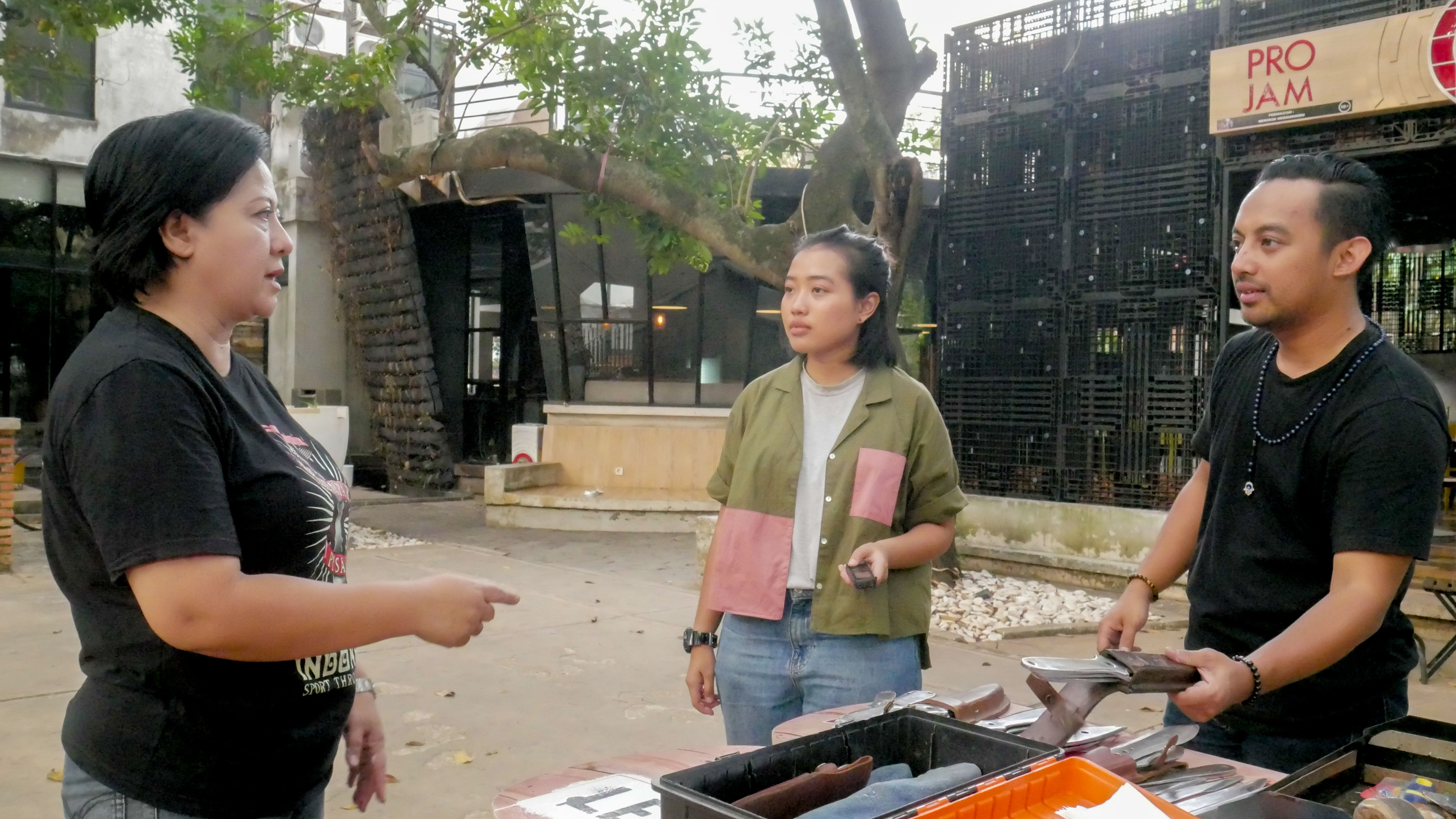
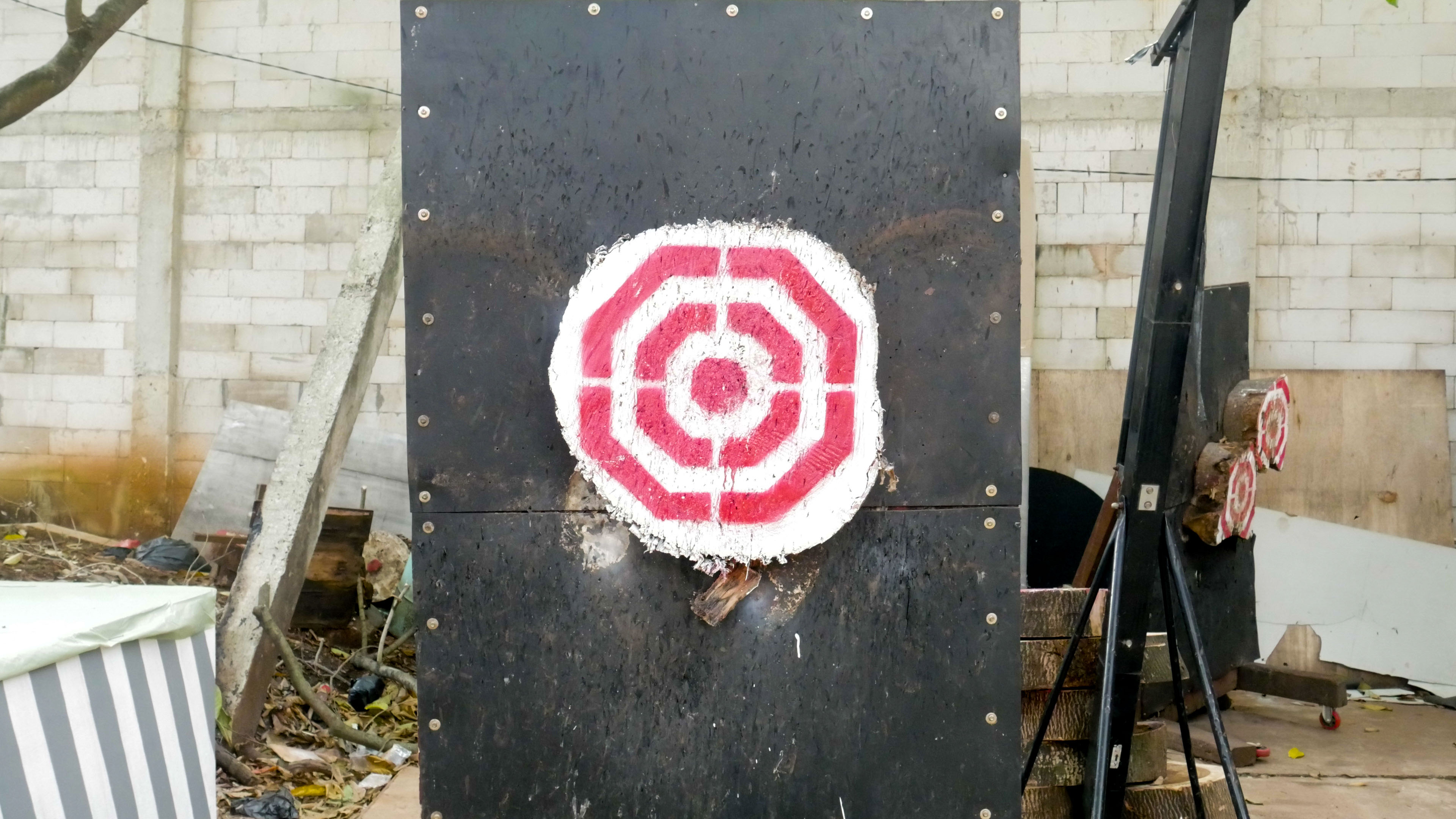
While waiting for Hendry to sharpen the knives, I walked around the premises. I was surprised to find hard wooden targets that were pretty small. In Pak Eko’s videos, the targets look softer. Hendry later explained that three targets are typically used in one game. They’re placed in a V shape, with the right and the left targets mounted higher than the middle one. The smallest of them has a 50 cm diameter, and inside each one are five sections that are worth different points. The outermost section is worth one point, and the bullseye is worth five. I have to admit, it was getting harder that it looks in Pak Eko’s videos.

Hendry taught me different techniques that day. The first one is called the full spin, which is where you throw the knife to rotate fully. Then there is the half spin, where the knife will spin half a turn. This is useful when you’re fairly close to your target. The last technique is the no spin, where you throw the knife in a linear motion.
The most commonly used technique is the first one, so that’s where I started. The knife used for this technique is usually made of steel weighing at least 200 grams and precisely 30.5 cm long. As we walked to the throwing arena, Hendry let me in a little a secret: we can nail a perfect full spin using a little bit of math.
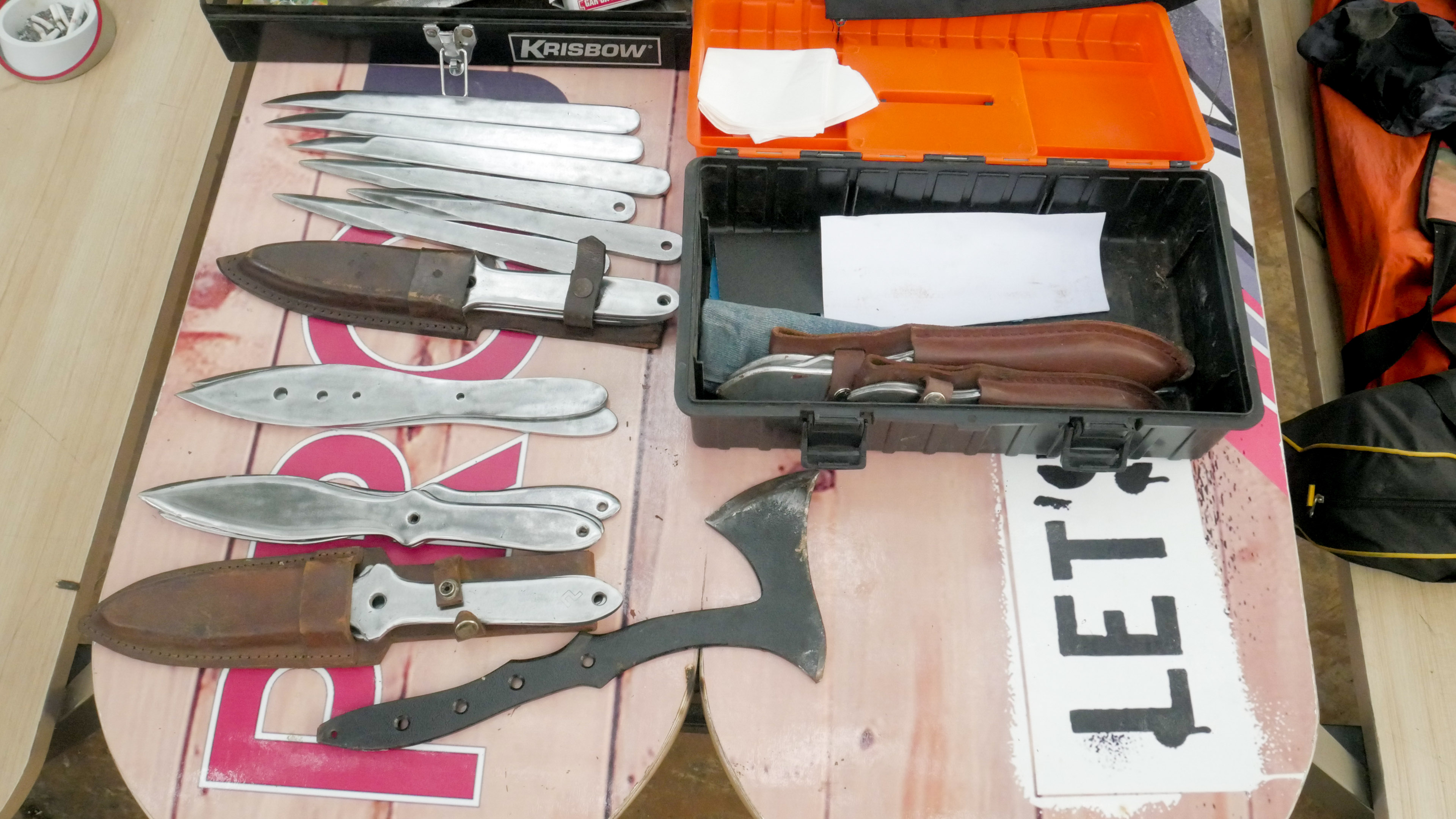
“Say, we’re going to throw it from a distance of two meters,” he told me. “Then we hold the blade, because the distance is an even number. If it’s an odd number, we hold the handle.”
To make sure that the blade will stick in the target, you have put into account the length of the knife, and the distance between where you stand and the target. If the knife is 30.5 cm long, spinning 180 degrees from two meters away, you can pretty much tell whether it’s the blade or the handle that will stick in the target. This could be the reason in many of Pak Eko’s videos, his knife’s handle is always the one hitting the target. He should’ve thrown the knife by holding the other end. But obviously he’s a legend, he can do whatever he wants.
After a short briefing, it’s time to give this a try. I was a bit nervous not about whether my knife would stick, but whether it would hit me back like a boomerang, though that’s probably impossible.
I held the knife with my right hand, and as instructed, I did so as though I was doing a handshake with it. I pulled back my right forearm, trying to gather all the energy I had in my body and then threw it at the target. As I was about to throw it, I saw Pak Eko’s face in my head. He’s cheering for me. I knew I was going to nail it.
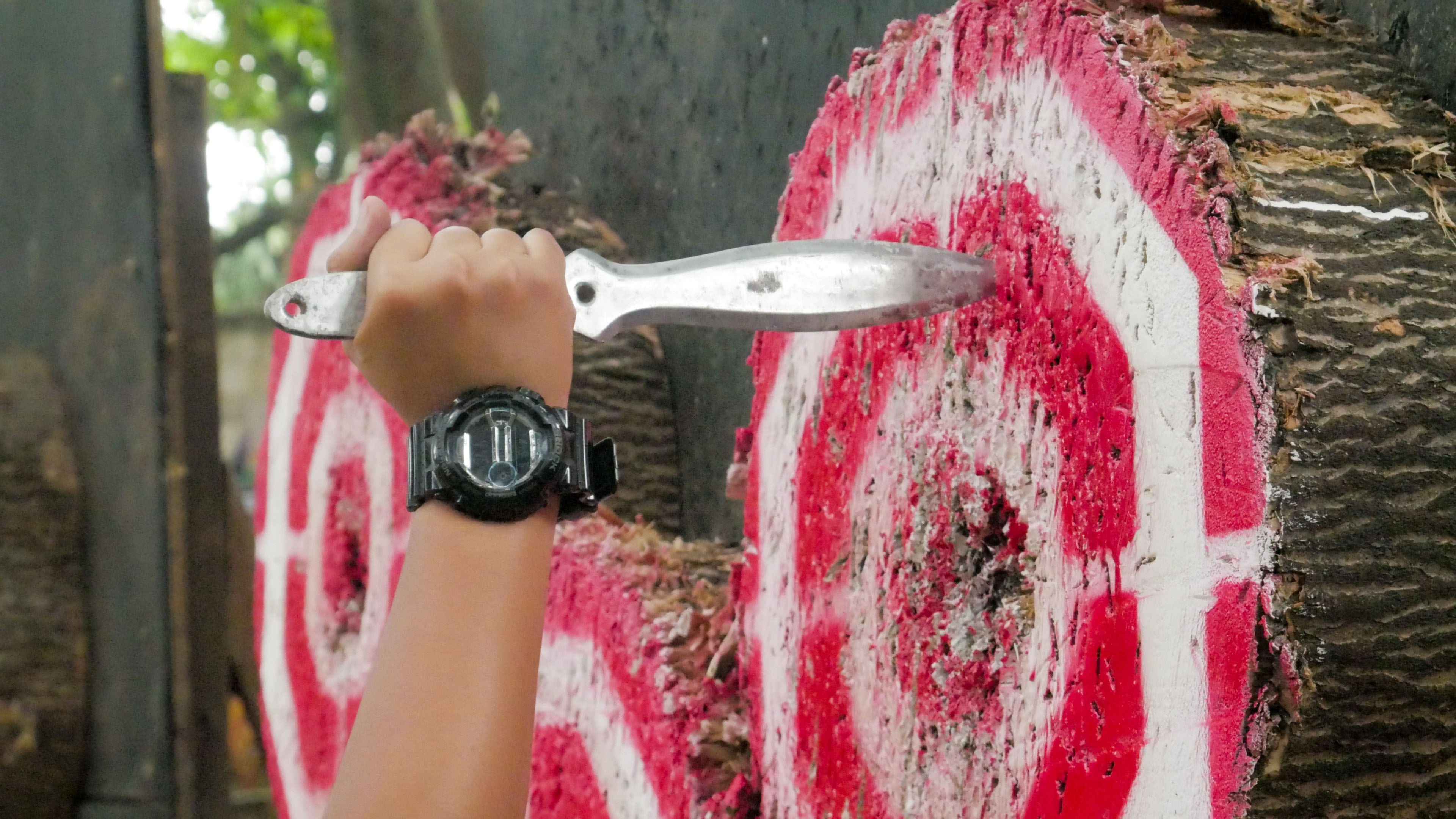
But I didn’t. My knife hit the target lightly and fell to the ground—my throw wasn’t strong enough. I should’ve released the knife when my hand was parallel to the target, Hendry said.
On my second try, I hit the target and everyone in the arena shouted like the children do in Pak Eko’s videos. The throw earned me four points, as my knife landed close to the bullseye. If he was there, Pak Eko would’ve been so proud.
My success turned out to be just a beginner’s luck. I failed again on my third try as my throws became inconsistent. Sometimes my knife hit the target, sometimes it missed. The best I could do was hitting the target twice in a row. It’s time to face that I’m never going to be as good as Pak Eko.
“If you’re not consistent, it means your movement changes every time,” Hendry said. “The key is to understand what you did right and how you did it. Try to mimic your previous success, use the same mindset, and hopefully you can throw the way you did.”

Before I took off, I asked Hendry for a short evaluation session. He told me that what I was missing were balance and timing. Sometimes I released the knife too late, and other times, too soon.
OK, so it’s not easy to be like Eko. It takes consistency and precision. Though I still had a lot to learn, at least now I know I have a talent for throwing knives. I just need to sharpen it a little. Maybe one day I could even play against Pak Eko. Wish me luck.
“That Was Easy,” is an ongoing series where we send VICE’s writers get the pros to teach them new, difficult, or strange skills. Have an idea of something you want to see us try? Send us a tweet with the hashtag “#thatwaseasy.”
More
From VICE
-

Al Pacino in ‘Heat.’ Picture courtesy Warner Bros -

A large group of galaxies. Photo: ESA/Webb, NASA & CSA, G. Gozaliasl, A. Koekemoer, M. Franco, and the COSMOS-Web team -

Photo: Micaela Ricca / Getty Images -

Screenshot: Amazon Prime
