
One of the toughest things to get over as a layman learning about mixed martial arts is the number of rules. For something which started out as ‘No Holds Barred’ and which prides itself on being ‘as real as it gets’, there sure are a ton of terms and conditions. Things like hitting the groin and gouging the eyes are pretty easy to understand—no one wants undertaking a professional fighting career to be a commitment to being both blind and sterile by the time you are thirty-five. Then there are ones that are a little harder: grabbing the fence for instance. If you aren’t familiar with why that isn’t allowed I heartily recommend you wait an hour or two after eating and then Google ‘degloving’. Heel kicks to the kidneys from guard and punches to the back of the head are a little harder, but once you understand the disproportionately sensitive nature of those targets (not to mention the unbelievably tedious fights legalizing the former method makes for) they seem pretty sensible too.
What you might struggle with is that a great many of your favorite fighters, no matter how admirable they are as technicians, as icons, and as people, cheat. You don’t stumble into the top of an established sport, most fighters are tremendously driven. To bother with diet and weight cutting and multiple training sessions a day and all the injuries and tedious rehabbing that goes with that lifestyle, you have to be completely invested in the cause of winning. Being that driven sometimes makes the line between ‘digging deep and finding a way to win’ and ‘foul play’ blurry. When Fritzie Zivic, known as one of the filthiest fighters of his day, publicly stated that everyone was cheating he was just the best at it, all the other boxers of his time got up in arms. Sports Illustrated put together an article with irate quotes from Gene Tunney, Nat Fleicher, Jack Dempsey and others. Similar to the way everyone is vehemently opposed to Performance Enhancing Drugs in the modern era and feels the need to make that clear whenever they can, even after they get caught using PEDs.
Videos by VICE
The interesting point raised by Dempsey in his reply was:
That’s a ridiculous charge for Zivic to make. Where does he get his facts? A fighter can be rough without being dirty. Sure I was rough, plenty rough, but never dirty. I probably hit some foul punches, but never intentionally.
Nat Fleischer, founder of Ring Magazine and one of the greats of fight journalism added:
I violently disagree. Zivic used foul tactics, but no champion I ever watched was a dirty fighter. Dempsey was occasionally called a dirty fighter because he never went to a neutral corner and he would crouch over a fallen opponent for the kill. He was within his rights; there was no neutral-corner rule at that time.
Both of these raise an interesting point. Fighters want to differentiate between rough and dirty. Between fouls and intentional fouls. Of course, assigning intention can be difficult in many cases and that is what makes the first foul practically a freebie in MMA. But while there are very few fighters who will go all out to gouge an opponent’s eyes like Gilbert Yvel so famously did against Don Frye, a great many fighters pushed into a desperate fight with high enough stakes might well find themselves ready to commit less severe fouls with little internal dialogue over the results. That is why we have referees after all, it is a lot to ask a man to fight like a demon and comport himself like a gentleman in the same instant.

Classy Gilbert.

Some of the greatest champions in the history of the sport have made their mark with some of the sketchiest ring tactics you will see. Ultimately it doesn’t show up on their record and it fails to impact how fondly we remember them. But bring up the fact that Chuck Liddell turned the momentum of at least three major fights by finding his opponent’s eye with one of his digits, or that Anderson Silva’s sudden ability to stop Chael Sonnen’s takedowns and hit him cleanly in their second bout coincided with Silva grabbing a big ball of cloth from the waistband of Sonnen’s shorts, and their fans will often take umbridge.


Certainly you would be pretty delusional at this stage if you were not willing to recognize that Jon Jones will hold his splayed fingers in the path of his opponent’s eyes until the referee stops him from doing so.

Here’s the great Royler Gracie using Eddie Bravo’s shorts to drag his legs in close enough to hit a double from seated guard in their first match. To Gracie’s credit, he at least made sure to write his being allowed to grab Bravo’s pants into the rules of their second bout.

And whether you’re a Jose Aldo or a Conor McGregor man, you would have to admit that both are pretty good at grabbing the fence to stop takedowns.
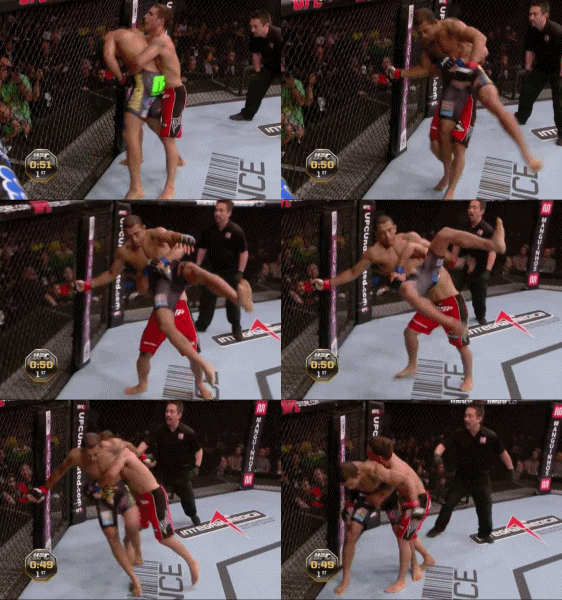.gif)

Where it gets interesting is where you are willing to draw the line. A fighter might only commit one serious foul in his entire career, but it might change a match and even fight history. A foul in a world championship fight can truly change the course of history. The number of big fights with sketchy moments where no one was bothered enough to demand a rematch is shockingly high.
With that being said, I receive emails every week asking me how I can heap praise on the methods of fighter x (though honestly, it’s usually Jon Jones) when they foul so flagrantly. Others have accused me of writing about foul play in an almost admiring manner. To this I must confess, cheating repeatedly without getting caught does impress me. Some fighters, like Evander Holyfield, turned fouling into an art. His ‘nodder’, the act of dropping the head below the opponent’s as they advance, is a masterpiece of subtlety and more damaging than any punch he could apply in the same opening. But then I am an admirer of fighting methods and the nodder is an undoubtedly effective one of those, it does not mean that I condone its use in a sporting contest.

The same method was clearly the turning point of Bellator’s Campos vs Guillard, yet it seemed like no one even noticed. Melvin Guillard’s management should be appealing the result of that fight.

But it gets more difficult to be a black and white fan of the good and denouncer of the bad when you begin to look at the greats under a magnifying glass. If you want to chastise every fighter who ever got away with fouling in the ring, the legend of Muhammad Ali ceases to exist. Cassius Clay would still have come up and won the heavyweight title with his blistering speed, but Ali’s return from exile was built entirely around his extensive and frequent use of the clinch. Holding is specifically prohibited in the rules of boxing and yet Ali’s was built around it once his legs slowed down. Were he actually being penalized for this, its doubtful that he would have become the most memorable figure in fight history.
Bending the Rules
Then we get into the more interesting grey area in between. The things which aren’t actually prohibited yet but perhaps should be. Returning to Jon Jones, linear low line kicks which hyperextend the knee are considered by many to be foul play, yet they are totally legal at present and have proven to be a game changer for some of the UFC’s longer fighters. (Though criticism over this technique often fails to stick to Holly Holm, Anderson Silva and Conor McGregor, because they are not Jon Jones.) I’m completely willing to admit that I feel uncomfortable when I see a good low line straight kick go in, but I also appreciate that it is the longest, straightest weapon against the nearest target and therefore will always be up there with the jab in terms of purity in fighting science. Equally when I see Shinya Aoki or Frankie Edgar slapping on a neck crank I think to myself if the neck cranked fighter doesn’t submit—as is fairly common in MMA when caught in a submission—does the cranking fighter just break his neck? Very uncomfortable indeed.
The rules of the game should always be evolving and answering the curious questions raised. When Jacare Souza bent the rules of inserting digits into the fence by using his toes to grip the fence and carry himself over his opponent’s guard, it was a damn neat trick. Flash forward to UFC 196, and some of the referees were calling fighters for putting their toes in the fence. The rules have not changed but that moment of “huh, can you really do that?” seems to be over. It makes sense I suppose, you can break a toe in the fence just as easily as a finger. Similarly, B.J. Penn’s smothering of opponents mouths with his hand was a strategy which many fans didn’t like, and occasionally a referee will now tell a fighter not to do this though again it is not specifically prohibited in the rules of the game.
But outrage over a foul which might not actually be a foul is nothing new. In 1771, Ireland got its first champion of London (which pretty much meant the world back then) in Peter Corcoran. Corcoran won the title in the shortest bareknuckle championship bout on record by driving Bill Darts’ head into a ring post. No one knew quite how to feel about it. Similarly, when the great Daniel Mendoza finally lost his title to Gentleman John Jackson in 1795, the latter’s gameplan was to grab a hold of Mendoza’s lengthy hair and wail upon him with the other hand. Not particularly gentlemanly, and not popular among fight goers, but again no rule specifically prohibited it at the time.
The crux of the issue is this: your favorite fighter has fouled at some point in a big match. Whether it was heat of the moment or calculated beforehand, it has happened. If you want to write every fighter who commits the occasional foul off for life, you aren’t going to have many left to support or enjoy. You have to decide for yourself where ‘roughness’ becomes ‘dirtiness’ as Dempsey asserted, but watching fighters ‘bend’ the rules and find the loopholes will always produce the loudest and liveliest debates in fighting. I cannot pretend that I have never seen a quick headbutt or low blow and had a chuckle at the cheek of it, nor that I don’t admire the artful use of questionable strategies like the nodder at the highest levels of the game but honestly if I had to be outraged every time I saw a subtle and probably deliberate foul, I would spend far too much of my time being angry and not being able to enjoy the rest of this crazy sport.
More
From VICE
-

TORONTO, ONTARIO – APRIL 24: (L-R) James Hetfield and Kirk Hammett of Metallica perform at Rogers Centre on April 24, 2025 in Toronto, Ontario. (Photo by Jeremychanphotography/Getty Images) -

Screenshot: The Pokémon Company -

Robert Michael/picture alliance via Getty Images -

Screenshot: CD Projekt Red
