
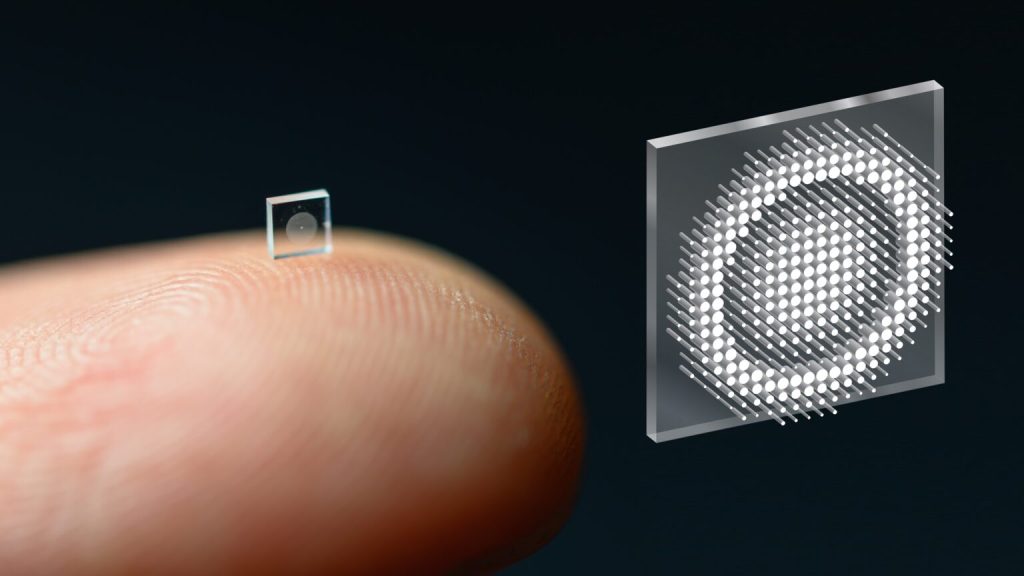
A newly-developed camera the size of a grain of salt can take clear, full-color images—at the level of cameras that are 500,000 times larger.
Researchers at Princeton University and the University of Washington created a new type of optical system, called a metasurface, to shrink the camera’s hardware down to size, and combined this with machine-learning image processing that enables the camera to produce clear images in natural lighting. Previously, micro-cameras could only produce useful images in perfect laboratory settings, according to the researchers. Their work is published in the journal Nature.
Videos by VICE
Each camera consists of 1.6 million cylindrical posts which interact with light to produce the images. These posts are as small as the human immunodeficiency virus (HIV). The surfaces are made from silicon nitride, a material that makes them compatible with computing microchip manufacturing. This means they’d be cheaper and faster to produce than current full-size camera lenses.

The researchers envision these types of cameras being used in procedures like endoscopies, where high-quality photos from inside a patient’s body also need to be as minimally invasive as possible. They also foresee these metasurfaces as covering the whole surface of devices like cell phones.
“We could turn individual surfaces into cameras that have ultra-high resolution, so you wouldn’t need three cameras on the back of your phone anymore, but the whole back of your phone would become one giant camera,” Felix Heide, the study’s senior author, said in a Princeton news release. “We can think of completely different ways to build devices in the future.”
More
From VICE
-

The Washington Post/Contributor/Getty Images -

K Park/Getty Images -

Chris Farley in 'Tommy Boy' (Photo by CBS via Getty Images) -

Dan Akyroyd and Bill Murray (Photo by Vinnie Zuffante/Getty Images)
