

Lately I’ve started hearing the word feminism being bandied about in the most unlikely of places. The male American politicians waging war on Afghanistan were the most bizarre example. It seems that one of the excuses they came up with to start bombing an already decimated country was to free women from the horrible confinement of the burqa. Suddenly, craggy old white men who never heard the word feminist became inordinately concerned with the rights of women halfway across the world, insisting this cruel injustice be put to an end.
Truth is, plenty of Western feminists support the idea of Muslim women using a garment to cover themselves. They acknowledge the Muslim belief that “neither sex should be allowed to exploit its own physical features for selfish gain, nor allow others to manipulate their sexuality.” American males may claim to see hijab as the subjugation of the female, but more likely they resent her inaccessibility as an exploitable product, an unknown entity hidden from their gaze and thereby unable to generate capital.
In a recent interview with Germaine Greer (The Female Eunuch), the old-guard feminist suggested that the real modern feminism is coming out of Middle Eastern and Muslim countries, the only places where average women actually congregate outside of the presence of men and form real bonds of sisterhood. In the West now, she said, women only have any real identity in relation to men, and there is often animosity between women in competition for male attention. Western females are expected to objectify themselves in the most extreme ways, which has everything to do with how men perceive women and nothing to do with the natural woman on her own terms. Women in Muslim cultures consciously use hijab so that they won’t be constantly objectified by men and valued only for male sexual arousal or commerce, and the fact that men and women are segregated in those cultures also allows women a certain amount of freedom to lead their own lives and form meaningful female solidarity. The notion that these women are subjugated and oppressed is coming largely from Western males who are pissed off that they can’t look at their bodies. From the point of view of these men they have no value unless they remove the veils and become objects of desire which can be exploited, or go into male-dominated occupations — like politics — and adopt a Western male consciousness.
Obviously there are Islamic regimes and governments such as the Taliban, the Saudis, and various North African countries that have used hijab as a pretext to keep women down, to deny them education or even the right to drive — essentially to enslave them. But according to the recent article “Veiled Intentions” by Norah Vincent, this is clearly a perversion of the way that the Prophet Mohammed intended hijab. The main Quranic passage which invokes hijab — Verse 53 of Sura 33 — is merely an entreaty by the Prophet to exclude one of his male companions from his relations with his wife on their wedding night. It is an appeal, if
you will, to manners and protocol in a milieu that was undoubtedly rife with machismo. Mohammed, in fact, made very direct statements about the treatment of females, such as “He who honors women is honorable, he who insults them is lowly and mean,” and “Treat your women well and be kind to them,” hardly an unreasonable request. Most importantly, hijab is meant to apply to both men and women who are merely asked to dress and behave modestly — for men to “cast down their looks and guard their private parts” and for women to “cast their outer garments over their persons” so that they “will be more proper” and “be recognized and not annoyed.” Considering the increasing vulgarity and pornographic explicitness of Western popular culture, these demure notions seem decidedly dainty.
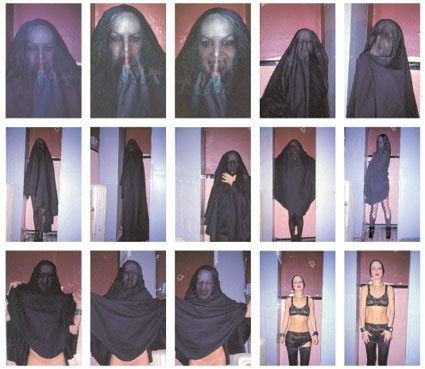
I know what you’re thinking (or at least those of you who know my work): How can a lowly pornographer be defending hijab and critiquing Western sexual exploitation? Easy. Despite the fact that it’s a multi-billion-dollar industry, pornography is still a relatively underground phenomenon, the biggest dirty little secret on earth. Convention dictates that explicit sexual representation remain somewhat veiled and hidden within prescribed standards of taste, allowing pornography to operate almost like an adjunct of the collective unconscious, a murky underworld of desire where people work out their sexual fantasies, no matter how politically incorrect (rape and racially based enslavement are two of the biggies). Although there’s no doubt that women are exploited in the world of porn, its existence is healthy and probably necessary. In my own work, I do shoot naked women in sexually explicit contexts, but in the realm of gay exploitation it has a different dynamic, in fact foregrounding the mechanics of sexual representation. My recent photos of the underground art star Kembra Pfahler lifting her black burqa to reveal the flower of her secret are a perfect example of this. (Besides, Kembra is a sex goddess, and thereby transcends the rules of representation.) The problem is when the hypersexual perversity of the pornographic imagination becomes normalized and exploited by the mainstream, which results not in sexual liberation — as one might expect — but in the reduction of all women (and often men) to so much meat.
A large part of the Islamic critique of Western culture is based on its overt decadence and flaunting of sexual excess. Early feminists recognized that there will be no revolution without sexual revolution, but in today’s advanced capitalism, sexual liberation seems to be the last thing on people’s minds.
More
From VICE
-

Screenshot: Epic Games -

-

Apple Watch Ultra 3 – Credit: Apple -

Screenshot: Deep Silver
