
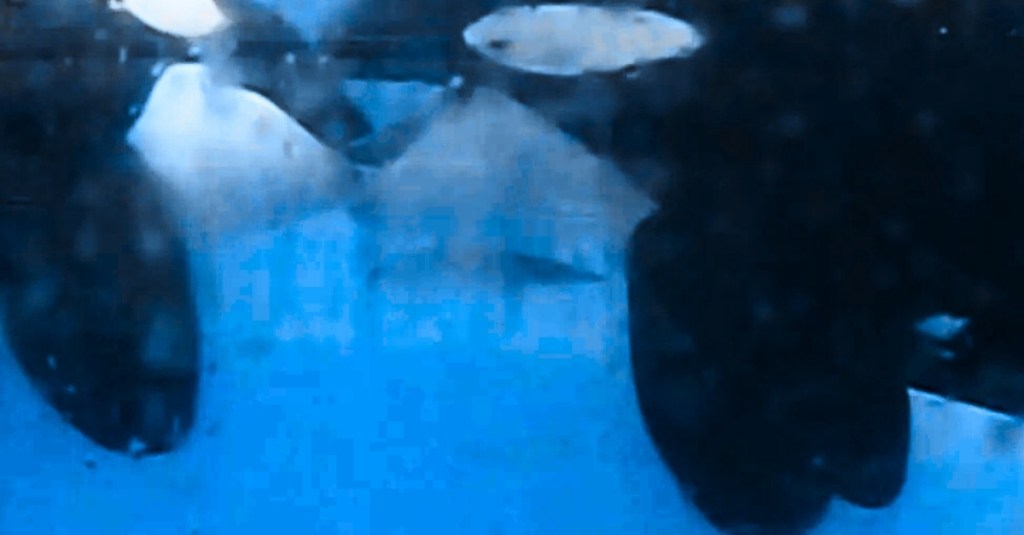
In a fjord somewhere north of Tromsø, Norway, two orcas were spotted French kissing, or so it seemed. Scientists have never observed this behavior in wild orcas before, and are not quite sure what it means. They’ve hardly ever seen it happen at all. Is it love? Is it boredom? Is it an act of violence?
The underwater make-out session clocked in at just under two minutes, and it marks the first time tongue kissing between orcas has ever been documented in the wild. Until now, orca tongue kissing his only been seen in captivity, like at Spain’s Loro Parque zoo, where four orcas once had a brief run as exhibitionist tongue-kissers before dropping the behavior completely.
Videos by VICE
The smooches were caught by “citizen scientists” during an October 2024 snorkeling trip in the Kvænangen fjords. The orcas engaged in three rounds of sweet mouth-to-mouth action before going their separate ways.
Two Wild Orcas Were Caught Tongue Kissing—But Was It Love Or Territorial Warfare?
Researchers are trying to decode what this all means. But the scientific consensus seems to boil down to a series of question marks. Tongue-nibbling could be a social bonding behavior, like how primates groom one another.
The closest behavior in the animal kingdom would probably be how some younger dogs and wolves will lick the mouths of the higher-ranking elders in a sign of respect.
Nobody knows why the orcas are doing it, but we also don’t know why orcas do a lot of the weird things they do. They’re kind of the quirky Manic Pixie Dream Girls of the sea. Every so often, they’re caught doing something weird, like wearing salmon as hats, because they’re not like other whales.
Speaking to Live Science, marine mammal expert Javier Almunia, co-author of the published study detailing the behavior, said the kissing may “serve affiliative purposes” and could be the orca’s way of resolving a dispute, which would mean they are literally kissing and making up.
The real discovery here might not be the kissing itself, but what it says about captivity. The fact that both captive and wild orcas exhibit this behavior suggests there is some instinct at play.
Meaning that studying orcas in captivity might be just as meaning that the data and observations gathered by studying orcas in captivity might be just as valuable as info gathered in the wild.
More
From VICE
-

Screenshot: Sony -

Perseomed/Getty Images -

Image Credit: GameSpot/X -

Screenshot: The Pokémon Company
