

I pursed my lips into a thin line of dispassion. I was desperate to be motionless. The wetness of half a dozen filled vases had cooled. I gripped his hair, wet too, buried between my bare legs, wiry arms pulling me down. I smothered a small panic, then let go, pissing in front of a hundred strangers, standing on a table in the middle of Copenhagen’s head library. Noise music had just invaded my life, smashed down my discomforts, and held me naked and vulnerable in front of a sea of faces. I stood and shivered on a red lit stage. I went home early that night. My girlfriend at the time walked in much later with her makeup heavy in black tears and her halter half torn open. I was jealous, curious, angry, excited.
We had an apartment on the street level. He stopped by over the next few weeks. He’d knock on the window, then swing himself in with his hands full of gifts. One day it was a novel by Georges Bataille for her and a vinyl for me. I had a childish fantasy of being the naïve American, Matthew, from Bertolucci’s film of polyamory and incest, The Dreamers. We had a secret pact no one knew the feeling of but us. We insisted on ourselves and our lives as a great experiment.
Videos by VICE
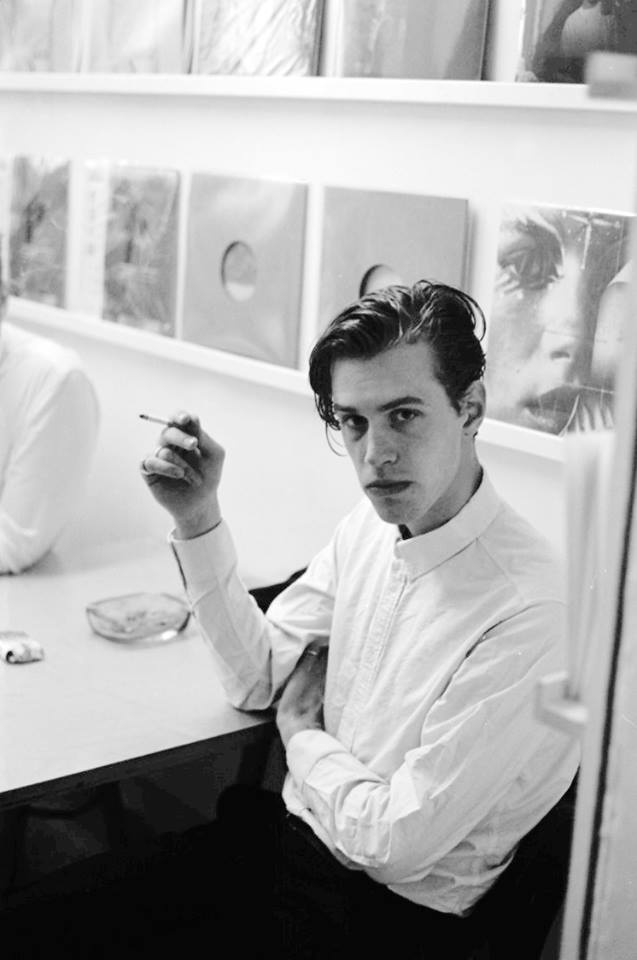
The Theo to my Matthew, (the incestuous brother of Eva Green in the film and a political revolutionary) was experimental music wonderboy (Russian media famously called him Scandinavia’s gay icon) Loke Rahbek. Two weeks before, I saw him perform as half of Damien Dubrovnik in The Tower, a venue worth the weight of its name in raw concrete. I stared from a corner by the stairs at the animal shape of him wrapped in a length of microphone wire. Tall with those penetrant eyes that take in the world wholly, as if to say, “I’ve got you.” Christian Stadsgaard, Damien Dubrovnik’s other half, wrestled with a jagged plane of metal held in front of his face. He could have been fist-fighting the devil.
Loke and Christian own the small press label, Posh Isolation, that releases Damien Dubrovnik, their various other side projects, and multiple other bands that share in their capricious aesthetic. A selection of those bands — Puce Mary, Communions, Sand Circles, Mischa Pavlovski, and Marching Church — will perform for Posh Isolation’s fifth anniversary tonight.

“At first starting a label was just a necessity because we were making music and we had no idea who else would release it. Who else we would you go to with our noise and screaming and be like “oh would you like to put this out on vinyl?”. I think none of us felt like walking around to record labels asking for pity releases. The label started with Christian and I shaking hands and saying okay, in three months we’ll have enough money to put out this first record, that we had recorded. And then we did that. That was the grand plan. Let’s get this record out.” Loke and Christian practiced and slept in a tangle of wires and sheets, trading bedrooms until they moved into the literal basement of their now shop. “I don’t even see it as a shop. Nothing in here is priced. The opening hours are ridiculous. This place shouldn’t be a business.”
Two years later, in 2011, Johns Lund and Sune Nielsen started Mayhem, a venue as impossibly conceived and successful as Posh. Christian speaks of Mayhem as the body to the mind of Posh, inextricable, “where you can manifest things in the flesh.” All bands are welcome and many of those affiliated to Posh have fashioned it into their work spaces, living in the hollows between the venues, or like Loke, in a door off from the venue’s bathroom in what could pass for a converted janitor’s closet. I have been surprised by his sudden appearance in the middle of a show, with the distant gaze of someone invested in the space of thought.
Posh speaks often of spaces, fantasies constructed in the instance of performance. “Invitations”, Loke says, “a language being built.” He compares their work to the construction of the Tower of Babel, the height of arrogance, a tower to reach Heaven and usurp God. Their Tower is a language of emotion with its myriad of expression in each new performance, or as Christian says, “each stone that you layer will bring something new to the table.” Loke talks of the contradiction between two performances in two days on tour in the UK, “a rave party at four in the morning with everyone on drugs and so much smoke you couldn’t see. And then the next day at three in the afternoon at a gallery with kids eating ice-cream.” “The hard part is to unfold something within what means are available to you,” Christian concludes.
Their relationship to Damien Dubrovnik is of a person to a city (“Dubrovnik” is a Croatian city), that singular megacity we all live in. I can stare out my window, right now, at the scape of Istanbul and horror at its similarity to all others. Damien Dubrovnik, Loke says, “has to be very human as much as falling in love is a part of you, as much as feeling sad is a part of you. It is very much a human being. It is an organism. It is about how these emotions overlap and how they overlap while contradicting themselves.” Damien Dubrovnik is famous surrealist Antonin Artaud’s Theatre of Cruelty embodied. “In a perfect theatre, you’ll be able to make emotions that are stronger than they are in the real world,” Loke quotes, “I want something more real than reality.” Artaud theorized that humanity’s pre-conscious emotions, those ineffable and unassailable by language, could be expressed in human physicality and unformed noise. Loke’s physical acts—choking, whipping, random acts of violence, are a direct feed to it. Action without the metaphor of language. Melody divested of its narrative. Noise.
Noise describes the emotional response to the pervasive constancy of the city sprawl. We shut ourselves out from it — we move out to conclaves of placid concrete and tamed lawns. Noise as music reflects and magnifies itself. Noise is madness, terror, aggression. Beauty, love, perfection. Loke and Christian see a contradictory chaos of human emotion, “What’s more aggressive than love? Than being in a relationship with someone else? Even though you love them you still fucking hate them. Damien Dubrovnik is much more complex than one key drone where you just push aggression.”
The first exposure to noise is sometimes revulsion. You can feel like you’re being assaulted. You can feel like you’re holding on to your psyche, like you’re blowing all apart. Then it gives way to a clean, clean violence, a little fire in you clearing away the brush. It’s a possession out-of-place with predictable limbs, but raw in its violence of body.
Antonin Artaud made his final work in 1947 from an asylum ward, the radio play “To Have Done With the Judgment of God”. He died shortly after, alone in the ward. “I suffer from the translation Mind or from the Mind-that-intimidates-things so as to make them enter into the Mind,” he said two decades before—a terminal disease of interpreting our reality. Pierre Schaeffer, the inventor of musique concrète, continued to experiment in this interpretation, “to collect concrete sounds, wherever they came from, and to abstract the musical values they were potentially containing,” with an ambition nothing less than a, “new mental framework of composing.”
When noise turned industrial in the 70’s with Throbbing Gristle, Cosey Fanni-Tutti, variously a porn star, performance artist, and musician, was the first woman to turn noise music into a sonic weapon. Industrial music signaled the first real coming into a transgressive aggression and sexuality. Posh Isolation is the manifestation of a second wave fronted by not men but women. Aggressive-as-fuck noctolaters (worshippers by night), who can appear possessed on stage, channeling some terrifying demon.

“What is your perception of beauty? This is a beautiful sound, this beautiful face — is this your perception of beauty?” Puce Mary — intimately tied with the rise of Posh Isolation — shouted on stage to the headlining band watching her from the audience, repeatedly hitting her forehead bloody with a microphone. When I saw her a day after, the crisscrossed lines of a microphone stood out, purpled on her bruised forehead. Watching her perform, it can appear that the alter-ego of Puce Mary is an uncontrolled force. “It’s not out of my hands. I trust this alter ego as a more controlled self,” she wrote, “I can pick out emotions and go into a specific state of mind, which ultimately makes me feel more like my true self. The sound of Puce Mary is what my perception of the human condition and myself translates to, and the identity of that varies from different songs as they are different expressions. It is driven by true emotion and reaction. Violence can be an example of reaction, but I am not a violent person. It is as interesting to me as much any primitive human emotion. Aggression and lust as basic states and instincts, deceitfulness and lies versus doctrines of morality.”
Loke left me with a last observation, sharing a drink in the basement, “I don’t find my experiments or my performances or my music in any way close to as absurd and immoral and degraded and degenerated as most of the stuff going on just outside this window. You walk by any bus commercial, turn on any television. What you find there is so much more grotesque, so much more disgusting, so much more immoral.” The quest for Posh Isolation is not of psychosis, but of desire for transcendence out at the edge of human experience. The space I had walked into was a revolt of the human spirit against jailers we couldn’t see. Noise music was a reaction, the violent bodily spasms symptoms of our inoculation to the urban life. I had gone to punk shows before that night at The Tower. I was apathetic to their politics, like most, I suspect, of my generation. Noise was a sound that got at something more human. It was the aggression, the hopelessness, the fear, the love, desire, and hate that had been stalking the corners of my head and my limbs. It was emotion, purely.
More
From VICE
-

Photo: jroballo / Getty Images -

-

(Photo: Micala Austin) -

(Photo by Michael Buckner/Variety via Getty Images)
