

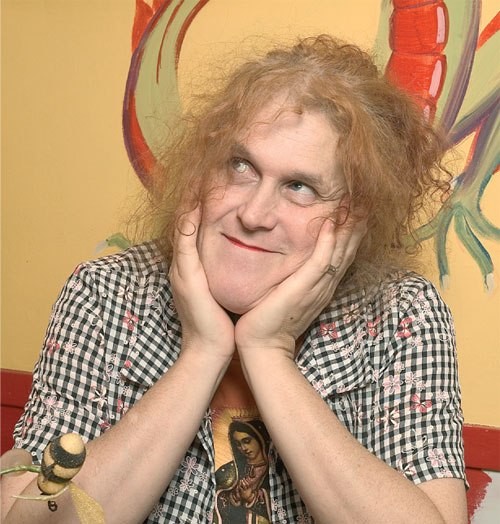
Photo by Bryon Miller
Baby Dee is a singer-songwriter-harpist-pianist with a voice like an angel who fell from heaven. She has played with Current 93 for a while now, and she just put out a solo record of strong and sad and pretty songs on the Drag City label.
Matt Sweeney is the best guitarist around, probably, and it’s even better that he is a journeyman. He’s played with everyone from Will Oldham to Cat Power to Johnny Cash. He met Dee when they were both in the touring band of Current 93. They became friends, and Matt—along with Will Oldham and Andrew WK—ended up going to Cleveland to provide musical support on Dee’s new record.
Here’s what they had to say about stuff.
Matt Sweeney: Dee, remember when we first met in Cleveland and we went to that Italian place and had drinks at the bar? Can you tell me again how you were feeling about your music’s place in the world then?
Baby Dee: I remember that. We had already done the sound check, and on top of it being my first harp-and-vocals gig in a rock venue, the girl who was doing sound didn’t have a clue about how to mic the harp and I couldn’t hear my vocals at all. I mean, it sounded like the microphone was turned off. Then she suggested I take some voice lessons!
So yes, I felt terribly out of place but the situation was so exquisitely wrong, and I so did not belong, that it helped me to realize that there wasn’t any other place I could think of where I did belong. It was sitting across the table from you that I had the thought that got me through the next three years—my mantra: “If you belong nowhere you can play anywhere!”
So it was your first time playing those songs in front of a “rock” audience, or something like that. Any memories of the show?
I remember Will Oldham and I were both wearing leopard-print pants. Hooray!
You showed up in a truck with lots of stuff in it. What was that equipment for?
That was probably tree-climbing gear. That was the tail end of my career as a tree climber. Some months back I had dropped a tree on a house and effectively put myself out of business. I went home the very day that happened and emailed everybody I could think of who could help me get back into the music business. One of those people was David Tibet from Current 93, and that’s probably how it got around to Will to have me open for him in Cleveland.
Is that what that song “The Only Bones That Show” is touching on?
Yeah, it’s about the whole tree-climbing thing—knots and hard places. The bowline is such a wonderful knot. It’s one of the greatest things ever invented. That song is also about rough times in general. I loved tree work but it’s a world where the bad things that happen are particularly bad.
That line about the rabbit coming out of the hole and going around the tree and back in the hole is how people learn to tie the knot. And the part of the knot where the rabbit goes around the tree is called the bight—it’s technically just a U-shaped bend of rope. But the bowline is where all the tension is accumulated. That place of tension is what makes the knot hold. That one little inch does all the work. The bight is the magic part of the bowline.
So for me the album is all about the inside and the outside, the real and the imagined, the seen and the unseen. “The Only Bones That Show” is about what an unholy bitch reality can be.
In “Compass of the Light” you sing from the point of view of a bee doing the “dance of eights.” What’s that?
Bees are so amazing. If a bee goes out foraging and finds a really great spot, she comes back to the hive loaded with nectar and pollen and does a dance that has the shape of an eight. Depending on the direction she’s facing in relation to the sun (every bee always knows exactly where the sun is) and how fast she beats her wings, every bee in the hive will know exactly where to go and what to expect to find there. It can be miles away. I think for a bee, that moment of getting to do the dance must be the axis around which her entire life revolves. They’re like so many little saints. I just love them.
Are you interested in old—like pre-20th-century—music?
Not so much these days, but yes, I liked old music. I suppose I’m like a lot of other people in that my life has been a series of obsessions. One of them was Gregorian music. I was completely obsessed with it and did nothing else for two or three years. It’s very hard to explain. I wasn’t particularly religious. That aspect of it kind of gave me the heebie-jeebies.
But it was strange. I had this very rich musical life but it was all going on inside—all by my lonesome.
How’d you get into it?
It started innocently enough. I wanted to be musically literate so I took a class in counterpoint. On the first day of class we were given the assignment to write a cantus firmus—basically a series of whole notes—the idea being that you learn to weave other melodies, gradually introducing half notes, quarter notes, suspensions, and the rules that apply to their “common usage.” It’s all very dull and complicated. Anyway, a cantus firmus is a sort of theoretical version of a Gregorian melody. I eventually got interested in contrapuntal music too, but that was an obsession away. I was way too happy to have discovered the Gregorian stuff to be bothered with anything else. I think my counterpoint teacher thought I was retarded.
What do you like about reading old music?
I like the simplicity of it and the miracle of having it jump off the page as a living, breathing entity. I love that combination of simplicity and scope—tiny and huge at the same time. I so admire that.
 You worked as a church organist. Tell me some things you liked about that.
I liked being up high. The organ was way up in the choir loft. I’ll never forget the first day I climbed up there to try out for the job and I looked down behind me—a good 30- or 40-foot drop—and it was like, “I love this! I want this!” And I liked playing an instrument with rearview mirrors. You know you’re playing one big serious motherfucker of an instrument if it’s got to have a rearview mirror. It was nice playing an instrument where you can play the melody with your feet if you want to.
It also gave me an unusual opportunity to get to know some very smart people who were people of faith. I realize now that’s kind of rare. Let’s face it. For the most part those who allow themselves to be perceived as faithful are morons. So I’ve always been grateful that I got to be friends with that rare and wonderful thing—exceedingly intelligent people of faith. It’s kind of funny. Being an organist—not a member of the parish or a member of the clergy—was a good thing. Priests, the good ones anyway, like to hang out with people who aren’t trying too hard to get into heaven. I also liked having the music connect with people’s lives in important ways at important times: birth, death, marriage, bingo…
I just have one more question: How’d you get to be so darn lovable?
It’s actually a lot of work. I have to practice doing cute dances all day long. I spend countless hours in front of a mirror smiling sweetly. I devoted years to the study of Shirley Temple movies. While the other hermaphrodites were out playing their hermaphrodite games, I had to stay indoors memorizing the lyrics to “The Codfish Ball” and “Animal Crackers in My Soup.”
But wait, I have a question for you, Matt. My favorite song on the album is “Fresh Out of Candles,” but I went into the recording session hating it and not wanting to do it. Will suggested letting you and Andrew have a go at it, and the two of you created a whole new groove for it, a completely different feel. For me that was the turning point. From that moment on I felt good about the whole record.
Wow, thanks!
So my question is: What happened? How did you do that?
I think we just broke the tempo out of its original shuffle feel.
You seem to have a really good way of working together, you and Andrew.
I’m glad you think so. Andrew and I used to do this thing where one of us would play an instrument and the other one would sing, and we had to make up a song on the spot. Maybe that process made us better at playing together and improvising in a song context. We’ve made up some real gutter-ball songs!
Videos by VICE
More
From VICE
-

Collage by VICE -

BarkBox -

TOLUCA, MEXICO – DECEMBER 04: Dave Mustaine, leader of Megadeth band, performing as part of day 3 of the Hell & Heaven Metal Fest 2022 at Foro Pegaso on December 4, 2022 in Toluca, Mexico. (Photo by Medios y Media/Getty Images) -

Kieran Frost/Redferns
