

A few days before the Texas abortion ban went into effect in September 2021, a QR code plastered on a Texas Tech University bathroom stall in Lubbock posed a question: “Need to be un-pregnant?”
The sticker was placed there by C, a rising senior, who estimates that she has distributed and posted between 150 and 200 QR codes around campus.
Videos by VICE
“People really, really don’t like abortion in Lubbock,” C, who asked to be identified only with her first initial due to safety concerns, told VICE News. A few months before C started distributing QR codes, it had been dubbed a “sanctuary city for the unborn.”
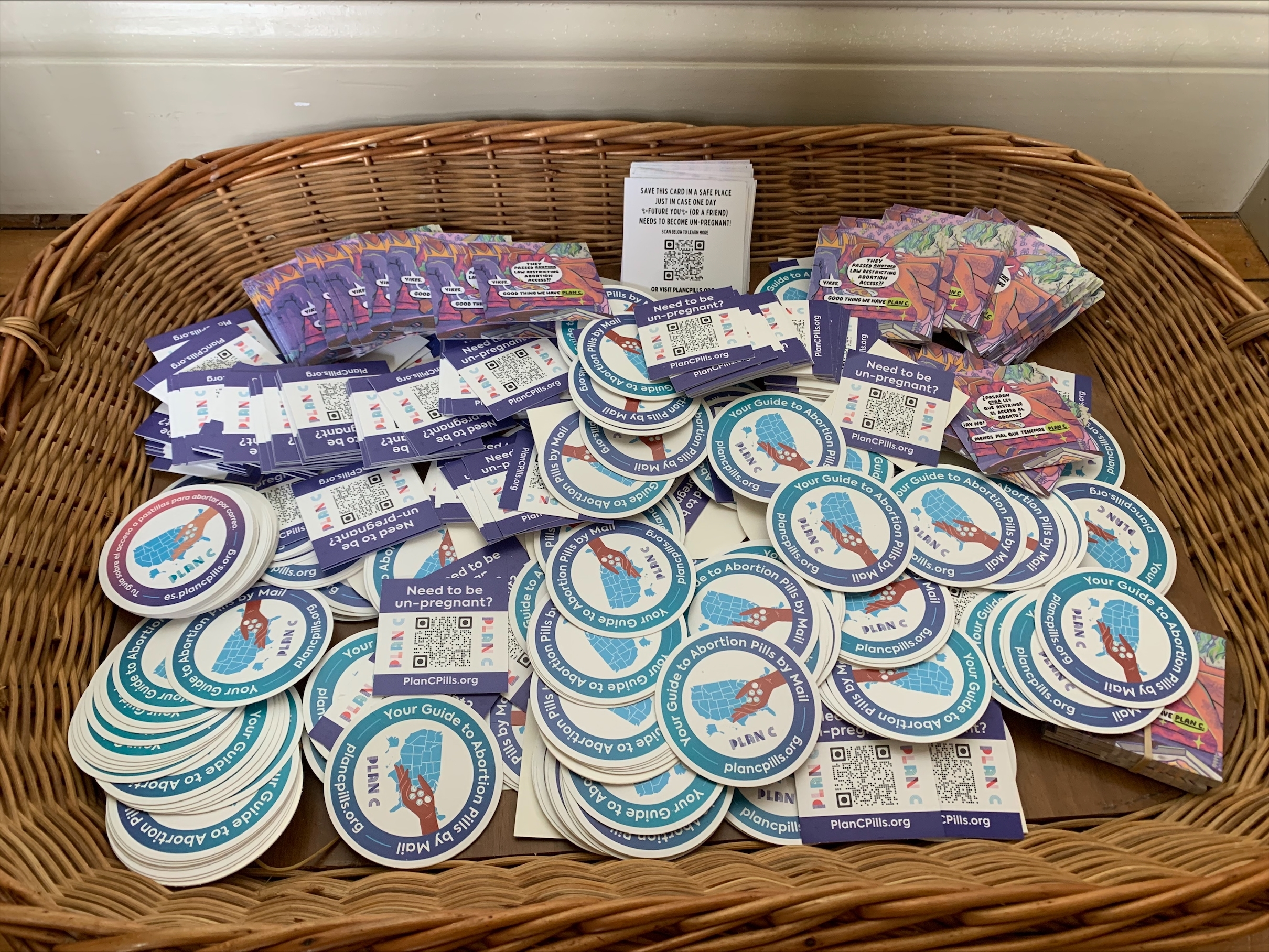
In states that have banned abortion, students like C are distributing QR codes that take users to websites that sell pills that induce abortion. The QR code stickers are the brainchild of Plan C, an organization that provides information about access to abortion pills. The code leads to the organization’s website, where links to platforms for purchasing abortion pills are a few clicks away.
For the first time in decades, students are returning to college campuses for the fall semester without the national right to abortion. For some students, this means finding creative ways of communicating information about abortion access.
“I think the fears that I have are the exact reason why it’s so important to have a way to anonymously spread information,” C said.
Launched in 2021, Plan C’s sticker program has fielded requests from every state, the organization said. Over half a million QR code stickers have been distributed—132,000 of which have been provided to individuals who said they were students.
“I think the fears that I have are the exact reason why it’s so important to have a way to anonymously spread information.”
C herself was first exposed to the QR code stickers when Plan C began distributing them to students on her campus. Shortly after her initial encounter with the group, she started distributing QR codes herself. “Save this card in a safe place just in case one day future you (or a friend) needs to become un-pregnant,” the card read.
She said that some students appeared disgusted upon being handed a QR code card but would briefly examine it en route to the trash can.
Then, to her surprise, some would quietly pocket it.
C said that for each person who ended up disposing of their QR code, there were probably ten more who kept it. “I think it’s important that we provide that information despite what people believe or what they advocate for. They need that access,” she said.
In 2020, medication abortions accounted for over half of U.S. abortions, according to the Guttmacher Institute. Some abortion pill providers, such as the group Hey Jane, are not currently shipping to the 19 states that have telemedicine abortion restrictions. And some people have already indicated that they will try to get around these restrictions, despite possible legal consequences.
Abortion restrictions tend to target people who provide abortions, not the people who undergo them. But there’s no guarantee that abortion patients won’t get swept up in a law enforcement dragnet—and, indeed, many already have. And although the vast majority of states do not have explicit laws forbidding self-managed abortion, experts warn that if a prosecutor wants to go after someone for having one or helping someone else do so, they’ll find a way to do it.
Even in states like Kansas, where in-clinic abortion is currently legal, the ever-changing post-Roe legal landscape has resulted in a patchwork of shifting laws and statutes that even those who pay close attention can find confusing. Abortion-rights advocates worry that even just providing information about abortion could potentially open them up to scrutiny from law enforcement.
“We think the moment that we are being censored and shut down from sharing information on a medically safe option in a certain state, then that is the moment we live in a very different United States.”
Amy Merrill, co-founder of Plan C, told VICE News earlier this summer that the organization has had conversations about threats to the legality of its work.
“We keep coming back to our First Amendment rights to share information,” Merrill said. “We think the moment that we are being censored and shut down from sharing information on a medically safe option in a certain state, then that is the moment we live in a very different United States.”
When Claire Burke, a rising sophomore at Barnard College, returned home to Kansas in possession of QR code stickers she obtained from Plan C at school, she didn’t hesitate to distribute them to friends and post them in public locations around Kansas City.
In Kansas, abortion remains a topic of contention even after voters upheld the abortion protections in the state’s constitution in August. Burke said that many of her friends at home were concerned prior to the vote, and when they approached her in search of more information, she would hand over the QR code.
“The biggest goal is to make sure that people have access not only to the information but to the pills themselves,” she told VICE News.
Elena LeVan, a law student at Washington University in St. Louis and member of advocacy organization If/When/How: Lawyering for Reproductive Justice, recently ordered 500 pieces of advocacy material from Plan C, including QR code cards and stickers for her organization to distribute during the first week of school. In Missouri, abortion is banned at conception except in cases of medical emergency.
But LeVan wanted to be prepared for the fall semester; she said she also plans to place them in “random” places, like toilet paper dispensers.
“I think our university hasn’t really taken a strong stance on abortion,” LeVan told VICE News. “So a lot of this is going to be left up to students to spread these resources and get people connected with information.”
A joint statement by the chancellor and the dean of the School of Medicine following the Supreme Court overturning of Roe v. Wade focused on “dialogue” as opposed to healthcare access. The debate surrounding abortion “is too frequently reduced to polarized points of view with little to no room for constructive dialogue… As a university that places great value on diversity of thought and opinion, we are far from homogeneous in our points of view on this or any topic.” The administrators then encouraged students to come together as a community in the aftermath of the ruling.
In addition to the Plan C materials, LeVan ordered QR code stickers from ineedanA.com, a platform that provides resources for individuals seeking an abortion, including links to websites selling abortion pills by mail. According to the organization, they have distributed over 2,000 packets containing about 24 QR code stickers per packet—all of which have been hand-packed by a team of five volunteers at a dining room table.
The organization, which has since limited its sticker campaign to donors, volunteers, and organizations, said it’s received over 200 sticker requests mentioning the word “campus,” as well as additional requests mentioning student groups and sororities.
In South Dakota, one activist started her own QR code sticker initiative. Taking advantage of a sticker sale through the graphic design website Canva, Krista prints stickers with QR codes leading to aidaccess.org, a service that ships abortion pills to the U.S. from abroad.
“It’s definitely not a perfect solution by any means,” Krista, who asked to be identified only by her first name out of concern for her safety, told VICE News. “But I think it’s a step in the right direction until we can see some significant changes in our political sphere and our legislature.”
On July 1, a law banning telemedicine abortion went into effect in South Daokta. Gov. Kristi Noem also recently announced that she would take action toward implementing a ban on mail-order abortion pills, but that individuals seeking them should not face prosecution.
In addition to plastering the stickers around various cities in South Dakota, Krista has distributed them to Students for Reproductive Rights, a student group at the University of South Dakota. She also plans to issue them to a student group at South Dakota State University, about two hours north.
“Maybe they don’t think they’ll ever need it, but one day something unexpected happens and they may be like, ‘Well, maybe I should see if that QR code if that sticker is still there.’”
The current president of Students for Reproductive Rights at the University of South Dakota, Lexi McKee-Hemenway, lauded the QR codes because they’re discreet and easy to use. McKee-Hemenway said she herself has been distributing QR codes since receiving them from Krista, and though she has yet to distribute them on campus, she anticipates seeing them around in the fall.
“It’s so much easier to be able to just go up and scan the code and be taken somewhere versus having to type in a whole entire web address,” she said. “I want people to have access, I want them to be able to get their necessary healthcare… Even if that means that they have to do it themselves.”
Burke, the sophomore at Barnard, said that if she were to encounter any opposition, she feels confident her community would back her up.
“Anyone who organizes in red states is used to resistance, and I think that this is an especially volatile issue,” she said.
In Texas, where private citizens can file civil lawsuits against anyone who performs or “abets” an abortion, C is more concerned about action being taken by Lubbock residents, rather than by her fellow students. Despite her fears, she continues to distribute the QR codes in the hopes of providing students with information and options.
“Maybe they don’t think they’ll ever need it,” she said, “but one day something unexpected happens and they may be like, ‘Well, maybe I should see if that QR code sticker is still there.’”
Carter Sherman contributed reporting.
Want the best of VICE News straight to your inbox? Sign up here.
More
From VICE
-

Screenshot: Blizzard -

Screenshot: Epic Games -

Screenshot: Wizards of the Coast -

Image: Bulkhead
